The industry likes to gatekeep seniority behind a decade of experience. They want you to believe that time spent in a chair is the only metric that matters. It isn't. Seniority is not a measure of time; it is a measure of the systems you can architect and the problems you can solve without supervision.
The path to becoming a self taught senior engineer is shorter than the traditional track if you stop focusing on syntax and start focusing on artifacts. I learned the hard way that nobody cares how you learned to code. They care what you shipped this morning.
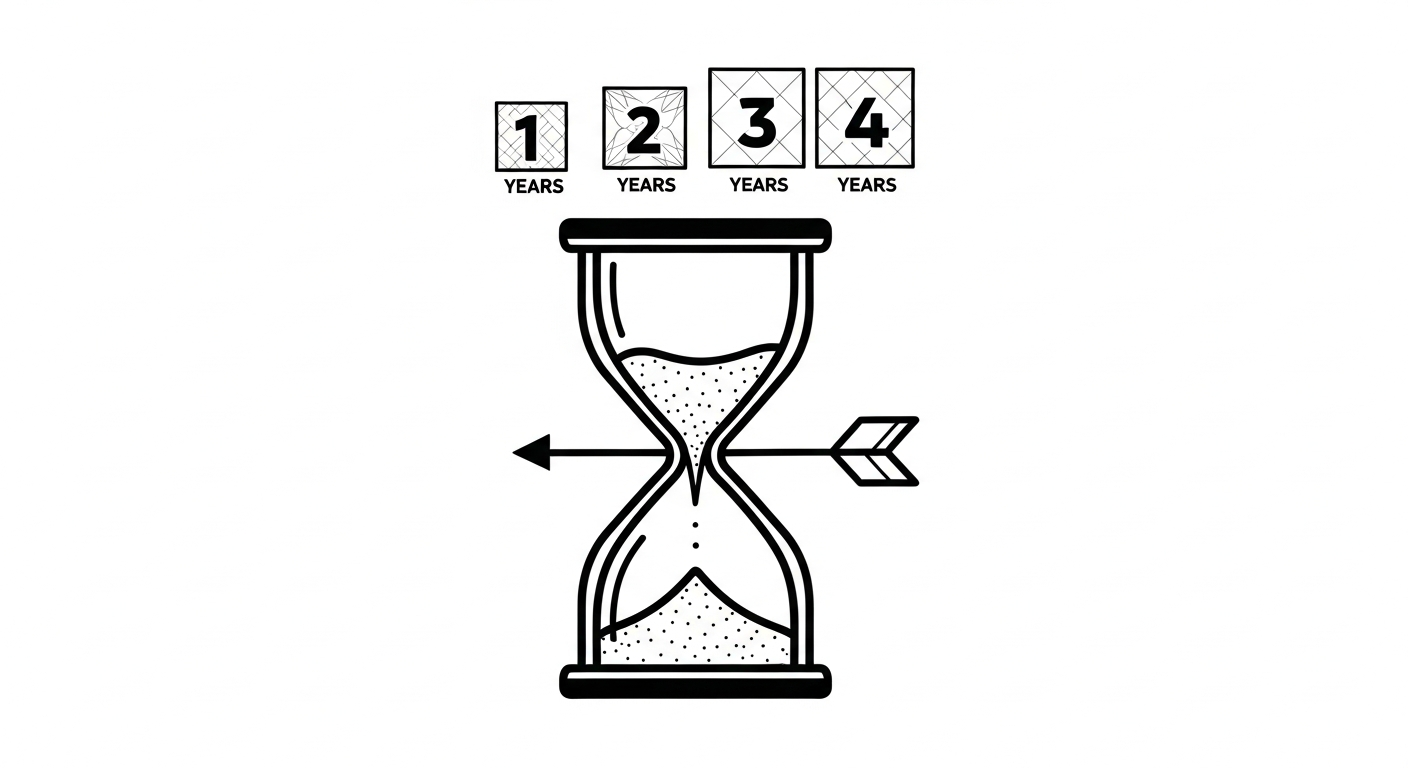
Here is the 4-year arc of an accumulated operating system.
The Artifact is the Credential
In your first year, you will be tempted to collect certifications. Don't. A certificate is a proxy for knowledge; a repository is proof of it. When I started, I didn't lead with my background in music or logistics. I led with what was shipping today.
Your goal in the early stage is to move from 'how do I write this loop' to 'how do I deploy this service.' You need to build things that exist in the real world, not just on your local machine. Whether it is a small utility or a full-stack application, the artifact is what credentials you. I spent my early days building and breaking things until the patterns started to emerge.
If you want to be a self taught senior engineer, you must become an integrator. You aren't just writing code; you are connecting a database to a frontend to a user's problem. The faster you can close that loop, the faster you move up the ladder.
Pattern Recognition Across Domains
My background isn't traditional, and yours probably isn't either. I’ve run music businesses, managed Army logistics, and handled operations for real estate teams. For a long time, I thought these were separate lives. I was wrong.
What actually defines a self taught senior engineer is the ability to see the underlying system. Music has a grammar. Logistics has a feedback loop. Code has a syntax. They are all the same skill expressed through different mediums.
When I was managing an eight-thousand-SKU e-commerce relaunch, I wasn't just thinking about the code. I was thinking about the supply chain, the data integrity, and the user flow. Seniority comes when you stop seeing 'the frontend' and start seeing the business logic that the frontend serves. You begin to notice that a bottleneck in a warehouse looks exactly like a bottleneck in a distributed system. Once you see the pattern, you can fix the system regardless of the stack.
Architecting Systems Over Writing Syntax
By year three, you should be bored with syntax. If you are still arguing about semicolons or the latest framework, you are stalling. A senior engineer is an architect of systems, not an author of one stack.
I don't identify as a developer of a specific language. I pick the instrument that fits the job. If I need to migrate 14 callables to shave 300ms off a cold start, I do it. If I need to build a custom agent orchestration layer like VERA to handle studio operations, I build it.
At this stage, your value is in your judgment. You are paid to say 'no' to complex solutions when a simple one will work. You are paid to anticipate where a system will break under load. You are building for durability, not for the sake of using a new tool. This shift from 'builder' to 'architect' is the most critical jump in the 4-year arc.
Agentic Engineering as a Career Accelerator
We are currently in a shift where the traditional rules of engineering teams are being rewritten. In my studio, I don't have a team of developers. I have AI as the operating layer. This is what I call agentic engineering.
As a self taught senior engineer, your job is to design the prompts, the workflows, and the agents that do the heavy lifting. I use Claude Code and custom MCP servers to handle research, monitoring, and infrastructure. This doesn't make me a power user; it makes me an operator.
If you are still writing every line of boilerplate by hand, you are falling behind. The senior engineers of the next decade will be those who can orchestrate a fleet of agents to ship products end-to-end. You aren't being replaced; you are being promoted to a system designer.
The Compounding Effect of Shipping
The final year of this arc is about compounding. Every system you build should make the next one easier to ship. I run a multi-product studio because I’ve built a monorepo and an operating model that allows me to launch new ideas in days, not months.
This isn't about working harder. It's about working in public and letting the work speak for itself. I don't use buzzwords or performative metrics. I show the commit, the before/after, and the outcome.
The journey of a self taught senior engineer ends when you realize that the code was never the point. The point was the system, the product, and the life it supports. I build to support my family and to stay present. The studio is the vehicle for that life.
If you are ready to stop following tutorials and start architecting systems, the path is open. It requires a builder-first mindset and a refusal to get bogged down in the hype.
Happy to talk.
—J
Next Step
If you're building your own path, start by auditing your current workflow. Identify one manual process in your build cycle and automate it using an agentic approach. Document the result and share the artifact.
Full implementation strategies for this transition are available in The Builder's Playbook — totalventures.io/resources/builders-playbook
Studio Notes
How I’m building the studio.
The operator’s log — systems, decisions, and what’s working.
Written by
Founder, Total Ventures
Solo-founder building a multi-brand product studio with AI agents. Writing about building, operating, and shipping.

