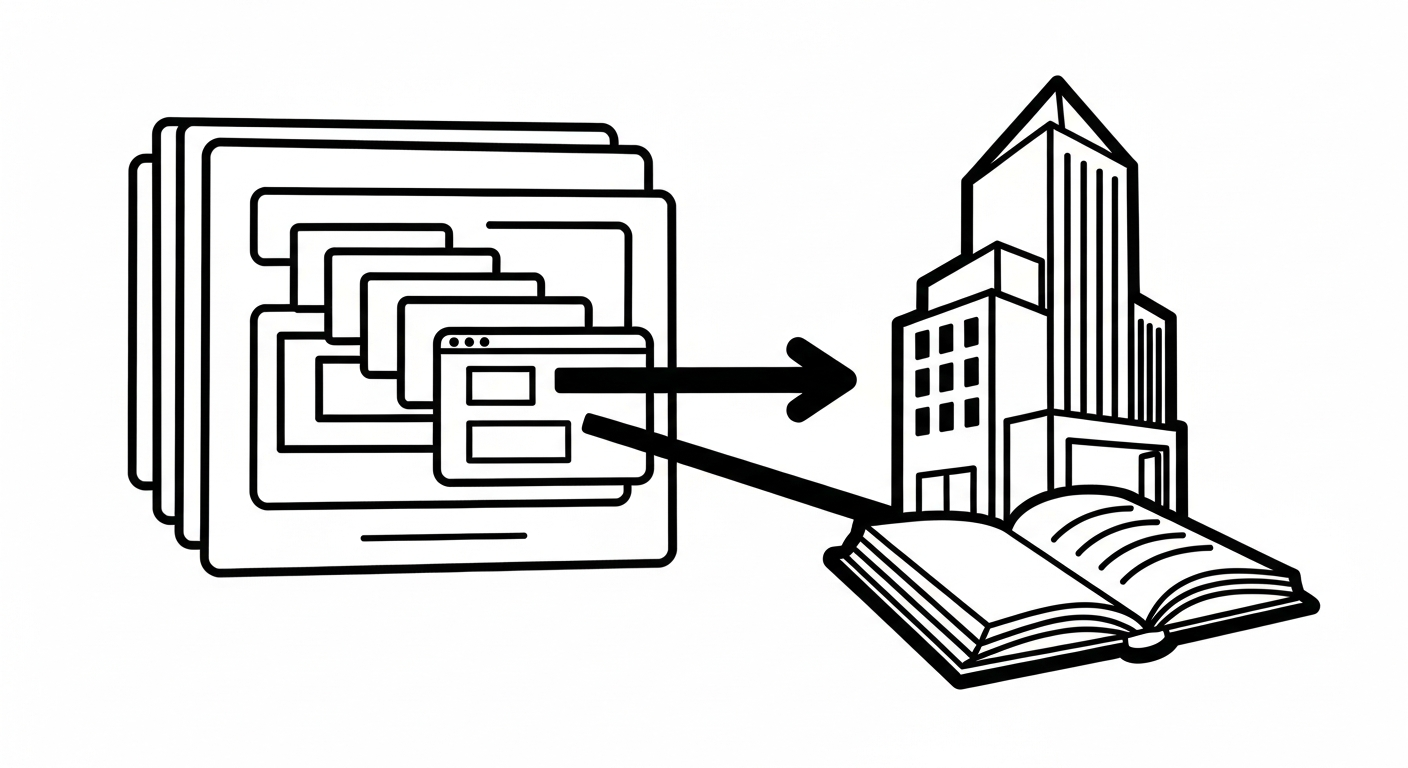
A career change into tech is often framed as a total reset. The narrative suggests you must discard your past—the years spent in music, the military, or operations—and start at zero as a junior developer.
This is a mistake.
I didn't come from a Computer Science background. My path went through jazz business at nineteen, logistics in the Army National Guard, and real estate operations. I’ve managed eight-thousand-SKU e-commerce relaunches and produced Super Bowl commercials. When I moved into software, I didn't see it as a new career. I saw it as a new dialect for the same operating system I had been building for two decades.
If you are navigating a career change into tech today, you aren't just learning to code. You are architecting a system.
The Myth of the Clean Slate
Most people approach a career change into tech by trying to memorize syntax. They spend months on LeetCode or chasing certifications in specific frameworks. They want to be an "expert in TypeScript" before they’ve ever shipped a product.
This is the slow way. It’s also the most fragile way.
Your value doesn't come from your ability to write a for-loop. It comes from your ability to recognize patterns across domains. Music has grammar. Logistics has feedback loops. Finance has ratios. These are all systems. Software is simply the most flexible medium for expressing those systems.
When I was running logistics in the Army, the problem was moving assets from point A to point B under constraints. When I build a backend today, the problem is moving data from point A to point B under constraints. The syntax changed; the logic didn't.
Porting Your Operating System
To make a successful career change into tech, you must identify your existing professional operating system and port it to the stack.
The Musician’s Ear for Syntax
If you have a background in music, you already understand nested structures and timing. A melody is a sequence of instructions. A harmony is a set of concurrent processes. You don't need to learn how to think logically; you need to learn how to map that logic to a terminal.
The Military’s Focus on Logistics
If you come from a military or operations background, you understand state management. You know that a plan is only as good as its error handling. In the field, you don't care about the brand of the truck; you care if the truck delivers the supplies. In tech, the framework is the truck. Focus on the delivery.
The Operator’s Focus on Outcomes
If you’ve run a business or a real estate team, you understand the money layer. You know that a feature that doesn't drive profit is technical debt. This perspective is rare in pure engineering circles. It is your greatest leverage.
Agentic Engineering: The New Pivot
The reality of a career change into tech has shifted. We are no longer in the era of the manual coder. We are in the era of agentic engineering.
In my studio, I don't have a team of junior developers. I have an operating layer of AI agents. I use Claude, Gemini, and custom orchestration layers like VERA to handle research, infrastructure, and boilerplate.
For someone pivoting today, this is an advantage. You don't need to spend three years mastering the nuances of CSS before you can ship. You need to learn how to direct agents to build the components while you architect the system. You are the integrator. You are the architect.
I learned the hard way that trying to compete on pure coding speed is a losing game. Compete on system design. Use AI as your team from day one.
Shipping in Public
Credentials don't get you hired in the current market. Artifacts do.
If you want to prove you’ve made the transition, stop talking about your "passion for learning" and start working in public. Build a tool that solves a specific problem from your previous industry.
- If you were in real estate, build an automated lead-scoring engine.
- If you were in music, build a metadata management tool for independent labels.
- If you were in logistics, build a route optimization dashboard.
When you show a hiring manager a working product—with a clean monorepo, automated deployments, and agent-driven documentation—they don't care that you don't have a CS degree. They see an operator who can ship.
Lessons Learned the Hard Way
I’ve made plenty of mistakes in this transition. I once spent three weeks over-engineering a Firebase backend for a product that had zero users. I focused on the stack instead of the problem.
I’ve also learned that:
- Profit beats revenue. Don't build big, fast, and brittle. Build small, durable, and profitable.
- The medium is secondary. Whether it’s a melody or a microservice, the goal is a functional system.
- Specifics beat abstractions. Don't tell me you're a builder. Show me the commit that shaved 300ms off your cold start.
Shipping Today
A career change into tech is not a move from "non-technical" to "technical." It is a move from one medium of systems thinking to another.
Stop apologizing for your path. Your background in music, the military, or operations isn't a distraction—it’s your edge. It’s the reason you can see the system while everyone else is looking at the code.
I’m shipping today. You should be too.
If you’re ready to stop the tutorial loop and start architecting systems, the first step is to document your existing operating system. Map your previous experience to technical concepts. Then, build the first artifact.
Happy to talk.
Studio Notes
How I’m building the studio.
The operator’s log — systems, decisions, and what’s working.
Written by
Founder, Total Ventures
Solo-founder building a multi-brand product studio with AI agents. Writing about building, operating, and shipping.
