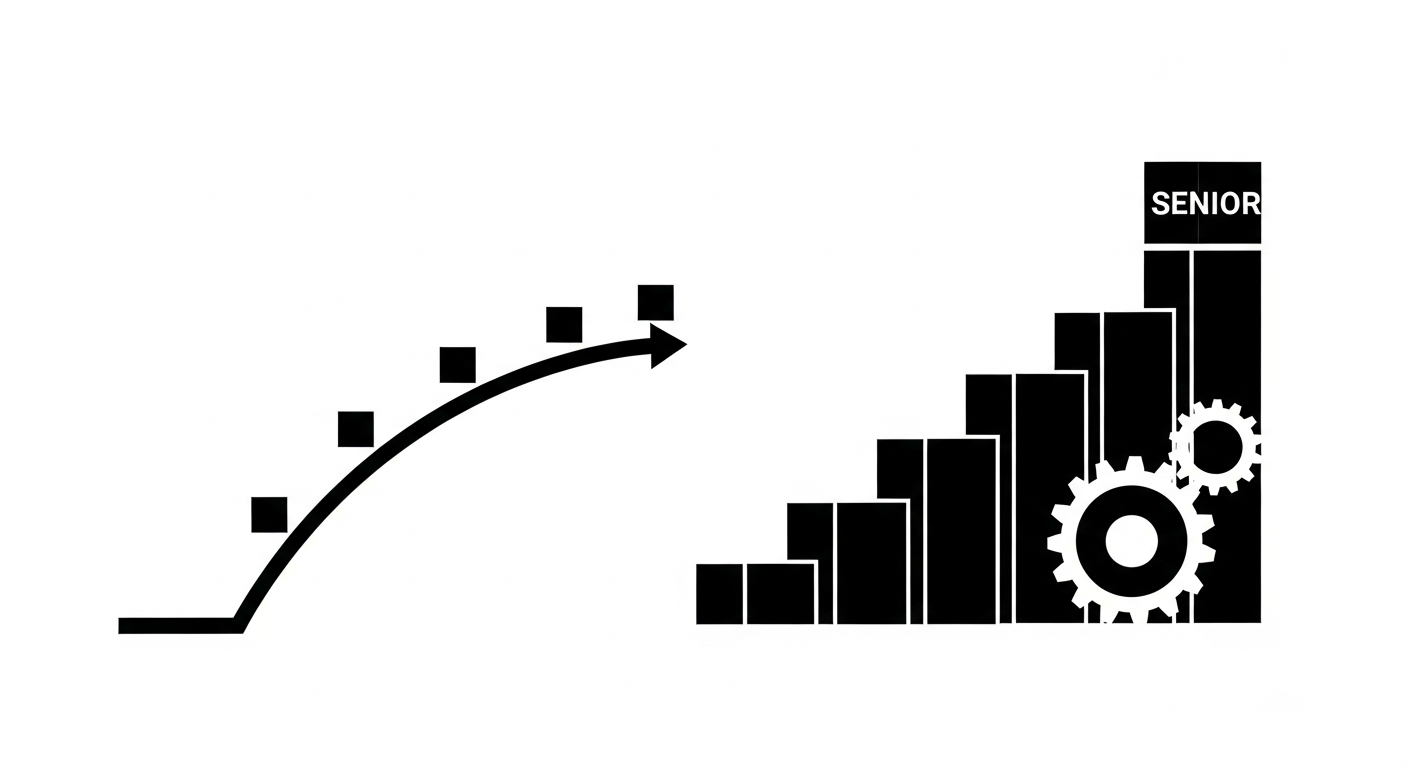
The path to becoming a self taught senior engineer is rarely a straight line. Most people treat it like a ladder where you wait your turn for a promotion. I treated it like a system to be engineered.
I didn't start with a computer science degree. I started by building things—music businesses, logistics operations in the Army National Guard, and real estate workflows. By the time I committed to software, I wasn't learning how to work; I was learning a new dialect for the systems I had been building my entire life.
If you want to reach senior-level output in a four-year window, you have to stop focusing on syntax and start focusing on the architecture of the business. Here is how that arc compounds.
The Fallacy of the Language Expert
Most developers get stuck in the middle because they try to become an expert in a specific tool. They want to be the person who knows every React hook or every TypeScript utility type. This is a dead end. Tools change. Frameworks bloat and die.
To become a self taught senior engineer, you must realize that the code is the most expensive part of the solution. A senior engineer is someone who understands that every line of code is a liability. I learned this the hard way while managing an eight-thousand-SKU e-commerce relaunch. The complexity wasn't in the frontend; it was in the data integrity and the synchronization loops.
When you stop identifying as a 'coder' and start identifying as a builder of systems, your value shifts. You aren't being paid to write functions; you are being paid to mitigate risk and create durable assets.
Compounding Systems, Not Tickets
In my first two years, I stopped counting how many tickets I closed. Tickets are noise. Instead, I focused on the artifacts.
Seniority is defined by the size of the problem you can own end-to-end without hand-holding. If you are waiting for a Jira ticket to tell you what to do, you are still a junior, regardless of your title.
I spent my time working in public and building internal tools that solved bottlenecks I saw in the production pipeline. For example, I noticed our Firebase cold starts were lagging. Instead of complaining, I migrated 14 callables and shaved 300ms off the start time. That is an artifact. It is a measurable improvement to the system.
When you consistently deliver artifacts that improve the bottom line or the developer experience, the 'senior' title becomes a formality. The work has already earned the seat.
Agentic Engineering: The Modern Force Multiplier
Today, the definition of a self taught senior engineer has shifted again. We are in the era of agentic engineering.
In my studio, I don't have a team of junior developers. I have an operating layer of AI agents. I architect the systems, and the agents handle the research, the boilerplate, the monitoring, and the initial implementation.
This isn't about using AI as an autocomplete. It’s about building an orchestration layer. I use Claude Code, custom MCP servers, and an internal agent orchestration system I call VERA. This allows me to ship at a volume that previously required a full engineering department.
If you are a self-taught builder today, your goal shouldn't be to write more code than the next person. Your goal should be to architect better systems that AI can help you execute. You are the conductor, not the first violin.
Pattern Recognition Across Domains
My background in Army logistics and music production wasn't a detour; it was the foundation. Logistics is just a series of state machines and edge cases. Music production is just signal processing and interface design.
When you look at software through the lens of other industries, you see patterns that others miss. You realize that a database migration is just a supply chain pivot. You realize that a clean API is just a well-composed melody—it has a grammar and a rhythm that makes it intuitive.
This cross-domain pattern recognition is what allows a self taught senior engineer to solve problems that stump those with a more narrow, academic focus. You aren't looking for the 'correct' way to do it in a textbook; you are looking for the way that works in production today.
Shipping Today
The most important lesson I can give you is to keep shipping. Not 'learning,' not 'exploring,' but shipping.
A senior engineer is someone who gets the product across the finish line when things break. And things always break. I’ve had deployments fail during high-traffic events and databases lock up during migrations. You learn more in those ten minutes of high-stakes troubleshooting than you do in ten months of tutorials.
Stop asking for permission to lead. Start owning the system. Build small, build durable, and focus on profit over vanity metrics.
If you are building something complex and need a second set of eyes on the architecture, I am happy to talk.
Next Step
Review your current project. Identify one bottleneck that isn't in your job description—a slow build, a manual deployment step, or a recurring bug—and fix it today. Document the before and after. That is your first senior-level artifact.
Studio Notes
How I’m building the studio.
The operator’s log — systems, decisions, and what’s working.
Written by
Founder, Total Ventures
Solo-founder building a multi-brand product studio with AI agents. Writing about building, operating, and shipping.
