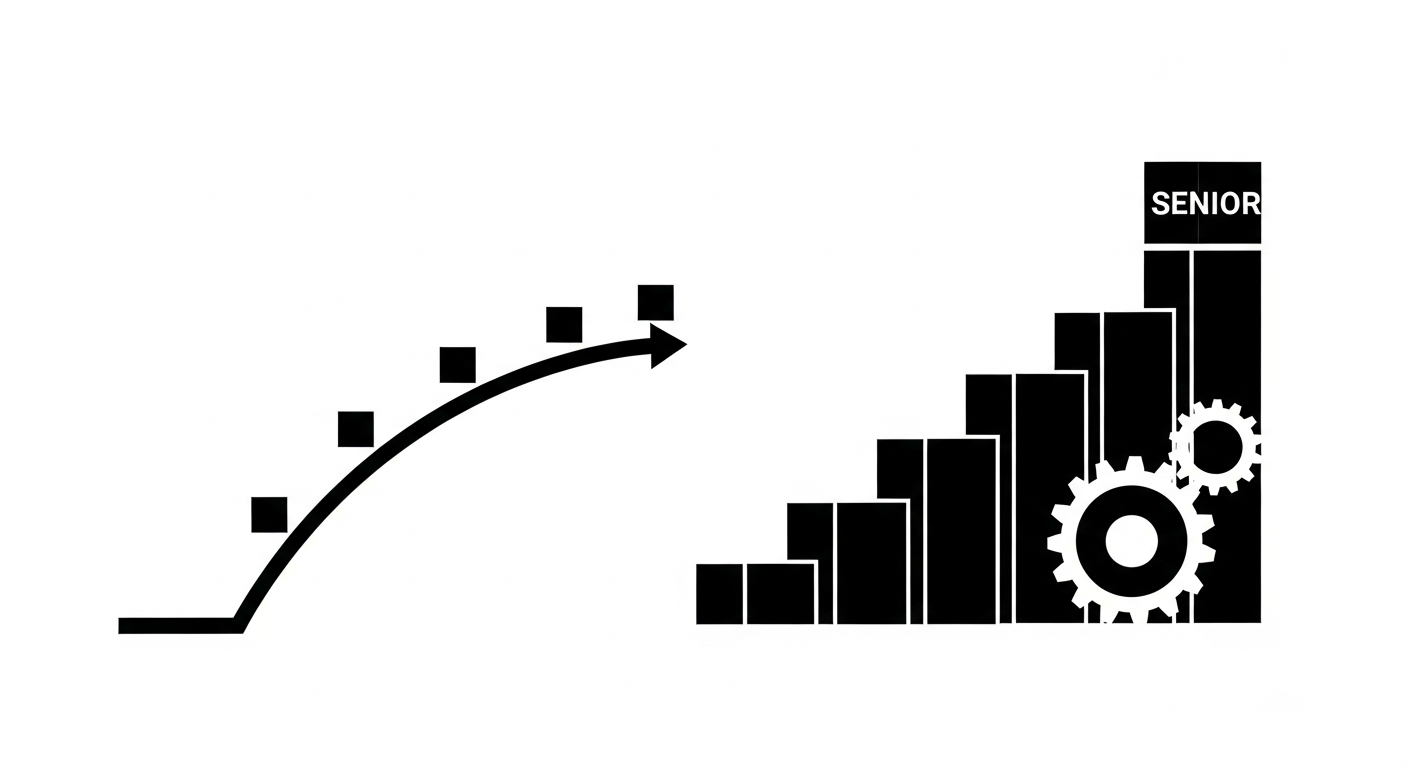
The path to becoming a self taught senior engineer is often framed as a series of hacks or a collection of certificates. It isn't. It is a four-year arc of compounding decisions, specific artifacts, and systems thinking. I learned the hard way that the industry does not care about your origin story; it cares about what you are shipping today.
If you are coming from a non-traditional background—whether that is music, logistics, or the military—you have an advantage that most traditional paths miss: you already understand how systems work in the real world. Software is just another dialect of that same logic.
The Myth of the Linear Path
Most people treat learning to code like a curriculum. They move from HTML to CSS to JavaScript, waiting for a permission slip to build something real. This is a mistake. The transition to a self taught senior engineer happens when you stop being a consumer of tutorials and start being an architect of systems.
In my own experience—moving from running logistics in the Army National Guard to managing an eight-thousand-SKU e-commerce relaunch—the medium changed, but the impulse to build didn't. You don't need a degree to understand a feedback loop. You need to see the pattern.
Year One: Shipping Artifacts
Your first year is about high-volume output. You aren't an architect yet; you are a builder. The goal is to move past the syntax and start understanding the constraints of the browser and the server.
Stop focusing on being an expert in a specific framework. Frameworks are instruments. You need to learn the music. In year one, your focus should be on:
- Working in public: Every commit is a record of what you know.
- Shipping daily: If it isn't in production, it doesn't exist.
- Specific artifacts: Build a tool that solves a problem you actually have.
I spent this phase building and breaking things. I wasn't worried about being a "developer." I was worried about whether the system I built actually worked when I turned it on.
Year Two: Pattern Recognition and Systems
By year two, you should have enough scar tissue to recognize patterns. This is where your previous life experience becomes your superpower.
If you have a background in music, you understand grammar and structure. If you have a background in finance, you understand ratios and flow. As a self taught senior engineer, you use these mental models to solve technical problems.
This is the year you stop asking "how do I write this?" and start asking "how should this be structured?" You begin to see that a backend and a melody are the same skill—they are both about managing tension and resolution within a set of rules.
Year Three: Architecting for Durability
Year three is where you learn the cost of your own decisions. You start maintaining the things you built in year one. You see where your code is brittle and where it scales.
To operate as a self taught senior engineer, you must prioritize profit before revenue and craft before scale. You learn to build small, well-run, and durable systems. You stop chasing the latest library and start choosing tools based on their longevity and the problem at hand.
I learned the hard way that a complex system that doesn't ship is worth less than a simple system that does. This is the year you move from being a builder to being an integrator.
Year Four: The Senior Operator and Agentic Engineering
By year four, the distinction of being self-taught should be invisible. The work has earned the seat. You are no longer just writing code; you are architecting the operating layer of a business.
In my studio, I don't use AI as an autocomplete. I use it as the team. This is what I call agentic engineering. I’ve architected a system where agents handle research, monitoring, and infrastructure. This allows a solo operator to function with the output of a full department.
As a self taught senior engineer in this era, your job is to design the system that the AI operates within. You are the architect of the feedback loops. You are the one who knows where the system breaks and how to fix it when the hype diverges from the practice.
The Artifact Over the Resume
I don't care about your years of experience in a specific stack. I care about the artifact. Can you show me a system you built that solved a real-world problem? Can you explain why you chose one database over another without using buzzwords?
Seniority is not a title granted by a company; it is a posture earned through shipping. It is the ability to stay calm when a production environment goes down because you’ve been there before. It is the discipline to write a README that a human can actually read.
How to Compound Your Progress
If you want to reach this level, stop performing and start building.
- Build in public. Let people see the commits, the failures, and the fixes.
- Focus on the system. Code is just the implementation detail.
- Adopt agentic engineering. Learn to orchestrate AI to handle the low-leverage tasks so you can focus on the architecture.
This is the blueprint for the self taught senior engineer who prioritizes craft over credentials. It isn't fast, and it isn't easy, but it is durable.
If you are building a studio or looking to integrate these systems into your workflow, I am happy to talk.
Work through this in a 1:1 strategy session through Total Ventures — totalventures.io/booking
Studio Notes
How I’m building the studio.
The operator’s log — systems, decisions, and what’s working.
Written by
Founder, Total Ventures
Solo-founder building a multi-brand product studio with AI agents. Writing about building, operating, and shipping.

