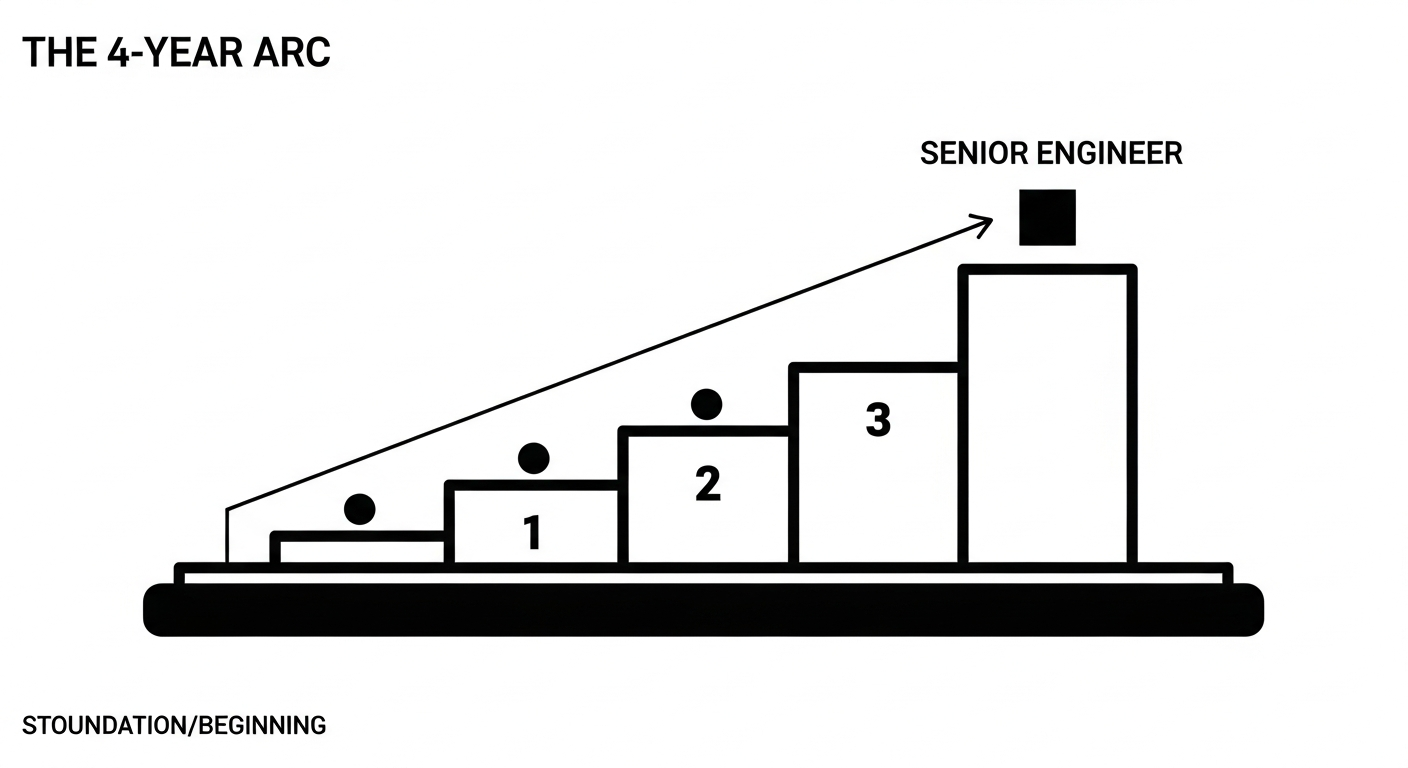
The industry likes to tell a story about linear progression. It suggests you spend two years as a junior, three as a mid-level, and eventually, if you survive enough stand-ups, you earn the senior title. This is a fiction maintained by HR departments. In reality, the path to becoming a self taught senior engineer is paved with artifacts, not time.
I learned the hard way that the market doesn't pay for your tenure. It pays for the complexity of the problems you can solve and the reliability of the systems you build. When I transitioned from running logistics in the Army and operating a music business into software, I didn't see it as a pivot. I saw it as applying the same operating system to a different medium.
If you are looking to compress a decade of growth into four years, you have to stop thinking like a coder and start thinking like an architect.
The Fallacy of the Linear Path
Most people get stuck in the first year because they focus on syntax. They want to be an authority on a specific framework. But frameworks are instruments, not the music. A self taught senior engineer understands that the code is often the least important part of the solution.
Seniority is the ability to see the system underneath the slogan. Whether I was managing eight-thousand-SKU e-commerce relaunches or building a multi-product studio, the core skill was pattern recognition. You aren't learning to write TypeScript; you are learning to manage state, handle failure, and reduce friction.
Year One: Shipping as the Primary Metric
In your first year, your only goal is shipping today. Do not build for scale you don't have. Do not optimize for a future that hasn't arrived.
Working in public is the only way to validate your progress. Every commit is a receipt. When I started, I wasn't interested in theoretical exercises. I built tools that solved immediate operational bottlenecks. If you can't point to a working artifact that someone else used to solve a problem, you haven't learned the lesson yet.
This is the stage where you build the muscle of finishing. Most developers are great at starting; seniors are the ones who ship the last 10% where the real work lives.
Years Two and Three: From Syntax to Systems
By year two, you should be moving away from the 'how' and into the 'why.' This is where you begin architecting systems rather than just writing functions.
What separates a junior from a self taught senior engineer is the shift from local optimization to global impact. You start noticing how a change in the database schema affects the frontend latency, or how a specific API design will break the mobile client six months from now.
You should be looking at feedback loops. In my studio, I don't just look at the code; I look at the deployment pipeline, the monitoring, and the cost of maintenance. A senior engineer builds things that are easy to delete and easy to change. Complexity is a debt you only take on when the ROI is clear.
Year Four: Architecting the Outcome
At the four-year mark, you are no longer just a builder; you are an operator. You are running a studio, even if you are an employee. You manage your own time, your own stack, and your own output.
This is where the breadth of your experience compounds. My background in music and logistics wasn't a distraction; it was the foundation. Music has grammar. Logistics has feedback loops. When you realize that software is just another way to express these patterns, you stop being a specialist and start being an architect.
As a self taught senior engineer, your value lies in your ability to take a vague business requirement and turn it into a durable digital product end-to-end. You aren't waiting for a ticket; you are defining the roadmap.
The Agentic Edge: AI as the Team
Today, the arc to seniority is being rewritten by agentic engineering. In my studio, I don't have a team of developers. I have an operating layer of AI agents that handle research, monitoring, and infrastructure.
Operating as a self taught senior engineer in an AI-native world means you are the conductor. You aren't competing with the model to write the best loop; you are architecting the system that the model executes within. I use Claude Code and custom orchestration layers like VERA to handle the heavy lifting. This allows me to focus on the architecture and the outcome.
If you aren't shipping with AI as your operating layer, you are working at a disadvantage. The goal isn't to use AI to write code faster; it's to use AI to manage more complex systems with less overhead.
The Compounding Operating System
Seniority is earned through the accumulation of lessons learned the hard way. It’s the 3:00 AM cold starts, the migrated callables, and the broken production environments that build the intuition required for high-level work.
I don't care about your years of experience in a specific library. I care about the systems you've built and the problems you've solved. The work credentials you.
If you are building for the long term, focus on the patterns that don't change. Languages will evolve, and AI will change the way we interface with code, but the need for clear architecture and reliable systems is permanent.
Build small. Build durable. Ship today.
Happy to talk.
Justin Tsugranes
Studio Notes
How I’m building the studio.
The operator’s log — systems, decisions, and what’s working.
Written by
Founder, Total Ventures
Solo-founder building a multi-brand product studio with AI agents. Writing about building, operating, and shipping.


