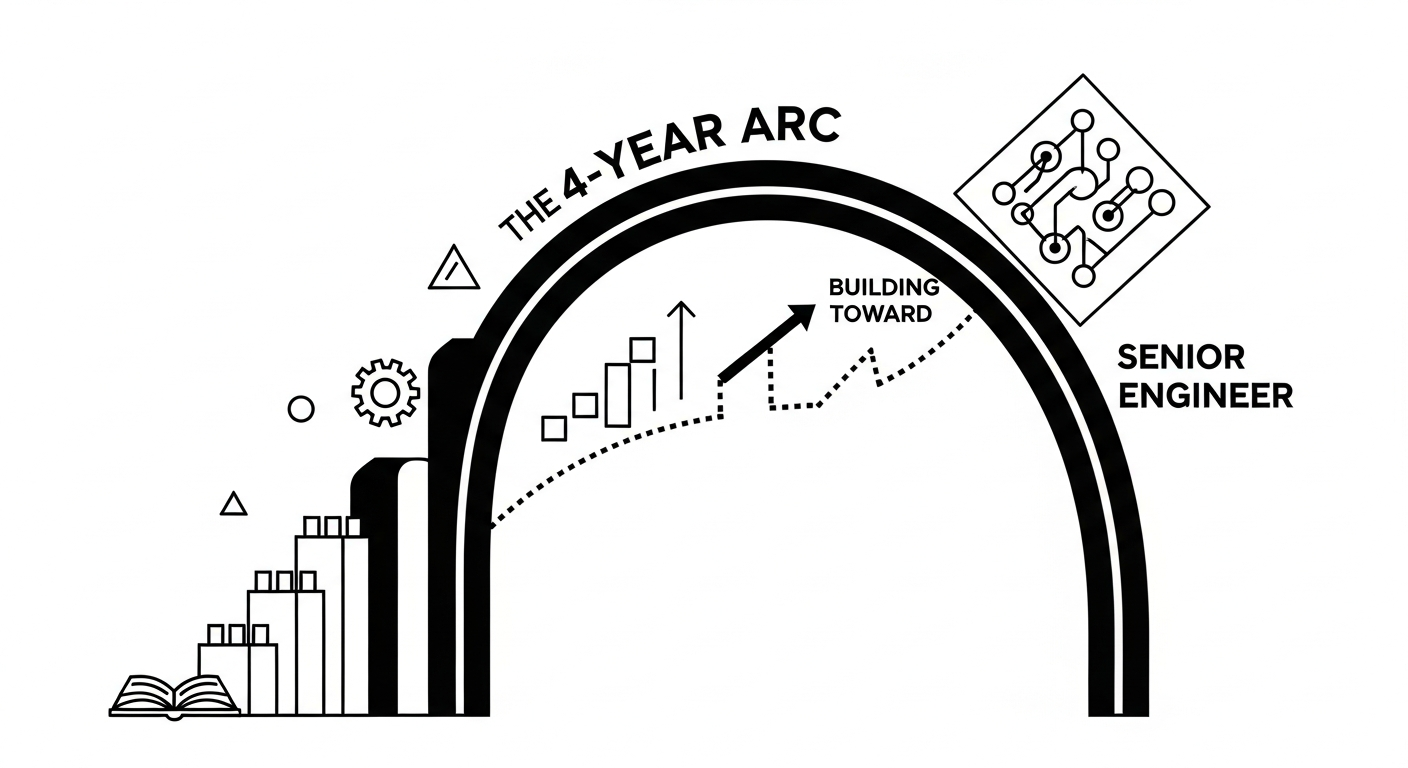
The path from writing your first line of code to operating as a self taught senior engineer isn't a linear progression of syntax. It is a transition from being a consumer of documentation to an architect of systems. In my four-year arc, the shift didn't happen because I mastered a specific library. It happened because I stopped looking at code as the product and started seeing it as the infrastructure for a business.
If you are navigating this path, you have likely realized that the industry's obsession with credentials is a distraction. The work credentials you. The systems you build, the artifacts you ship, and the problems you solve are the only metrics that matter. This is how you move from a junior contributor to a senior operator who runs a multi-product studio.
The Shift from Syntax to Systems
Most early-career builders spend too much time on the 'how' and not enough on the 'why.' They learn how to map an array or how to configure a router. These are table stakes. To operate as a self taught senior engineer, you must move toward pattern recognition across domains.
I learned the hard way that a well-written function in a broken system is still a failure. Whether I was running logistics in the Army National Guard or managing an eight-thousand-SKU e-commerce relaunch, the underlying logic was the same: feedback loops, bottleneck identification, and resource allocation. Software is just the latest dialect for these concepts.
Patterns Over Frameworks
Frameworks change. In four years, I have seen stacks rise and fall. If you anchor your identity to a specific tool, you are building on sand. Instead, focus on the architectural patterns that endure:
- State Management: Not just how to use a hook, but how data flows through an entire ecosystem.
- Observability: Building systems that tell you when they are breaking before the user does.
- Idempotency: Ensuring that your operations can be retried without side effects—a lesson often learned only after a database corruption incident.
When you stop being a developer of features and start being an architect of systems, your value to a business changes. You are no longer a cost center; you are a builder of assets.
Agentic Engineering: The New Senior Baseline
In 2024, the definition of a senior engineer has shifted. It is no longer enough to be a fast coder. You must be an orchestrator. In my studio, I don't have a team of junior developers. I have an operating layer of AI agents.
This is agentic engineering. It is the practice of designing systems where AI handles the research, the boilerplate, the monitoring, and the initial deployment pipelines. I built a custom orchestration layer called VERA to handle these tasks. This allows me to maintain a high shipping velocity without the overhead of a large headcount.
As a self taught senior engineer, your job is to architect the prompts, the MCP servers, and the agentic workflows that make the work possible. You are the lens through which the AI operates. If your architectural foundation is weak, the AI will simply help you build a mess faster. If your foundation is solid, the AI becomes a force multiplier.
Building the Operating Layer
Working in public has shown me that many people use AI as a glorified search engine. That is a mistake. To reach senior-level output, you must integrate AI into the infrastructure.
For example, when I migrated 14 callables and shaved 300ms off a cold start, I didn't just ask an AI to 'make it faster.' I used agents to profile the execution, identify the specific bottlenecks in the dependency tree, and suggest a modular architecture that reduced the initialization payload. The AI provided the labor; I provided the system design.
The Accumulated Operating System
Your background is not a liability; it is your edge. My experience in the music business and Army logistics provided a mental framework for software that a traditional computer science degree often misses.
Logistics is about moving things through constraints. Music is about grammar and tension. Software is the integration of both. When you approach a codebase with the mindset of an operator, you notice things others miss. You see the technical debt not as a 'mess,' but as a high-interest loan that will eventually bankrupt the product's velocity.
Profit Before Vanity
One of the hardest lessons I learned was to prioritize profit before revenue and craft before scale. A senior engineer understands that not every problem requires a distributed system. Sometimes, the most senior move you can make is to delete code or to choose a boring, stable technology over the latest hype-driven framework.
In my studio, we build small, well-run, and durable products. We don't build for the sake of complexity. We build to solve a problem and generate cash. That is the difference between a hobbyist and a professional operator.
Shipping Today: The Artifact-First Approach
If you want to be recognized as a self taught senior engineer, stop talking about what you are learning and start showing what you are shipping.
An artifact is a commit, a deployed URL, a technical README, or a performance report. It is the evidence of work. When I post a terminal screenshot, it isn't for engagement; it's to show the result of a system I architected.
Your 4-year arc should be a trail of these artifacts. Each one should be more complex than the last. Each one should demonstrate a deeper understanding of how systems fail and how to make them resilient.
Next Steps
If you are ready to move beyond the basics and start building systems that scale, you need a framework for your architecture.
Audit your current project. Identify one area where you are currently 'just a developer'—perhaps you are manually deploying or you have no visibility into your errors. Build a system to automate or observe that process. Move from activity to outcome.
Happy to talk.
Justin Tsugranes
Studio Notes
How I’m building the studio.
The operator’s log — systems, decisions, and what’s working.
Written by
Founder, Total Ventures
Solo-founder building a multi-brand product studio with AI agents. Writing about building, operating, and shipping.
