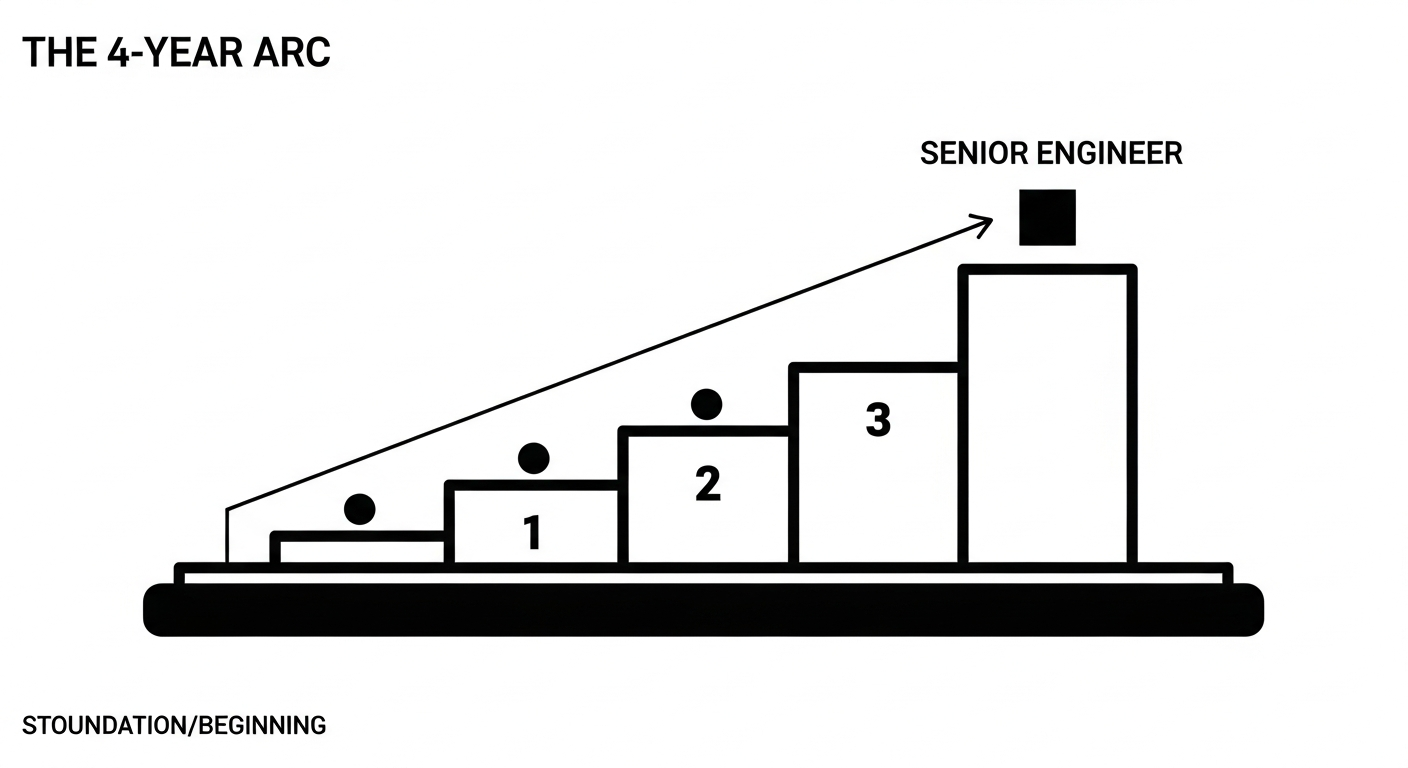
The path to becoming a self taught senior engineer is often framed as a struggle against credentials. It is not. It is a struggle against the temptation to remain a technician when the work requires an architect.
I have spent the last four years building a multi-product studio where AI is the team. Before that, I ran logistics in the Army and managed operations for high-volume real estate teams. These were not separate careers—they were the same system expressed in different dialects. If you want to reach senior-level output in a compressed timeframe, you have to stop viewing code as the product and start viewing it as the infrastructure for a business.
The Architecture of Compounding
Most developers spend their first few years learning how to use tools. They become experts in a specific framework or library. This is a mistake. Tools change; systems compound. To operate as a self taught senior engineer, you have to shift your focus from syntax to patterns.
In my first year of serious shipping, I focused on the artifact. I didn't just build a feature; I built a reusable module that could be dropped into the next project. By year two, those modules became a personal monorepo. By year three, that monorepo became an operating system for my studio.
When you work this way, you aren't starting from zero every Monday. You are building on top of everything you have learned the hard way. You aren't just a developer; you are an integrator of your own previous successes.
Moving Beyond Syntax
Seniority is defined by the ability to manage complexity, not the ability to write clever code. In fact, the most senior thing you can do is often to write less code.
I learned this during an eight-thousand-SKU e-commerce relaunch. The temptation was to build a custom engine for everything. The senior move was to identify the existing feedback loops and engineer the system to support them. We didn't need more features; we needed better data flow.
Building Your Own Operating System
If you are self-taught, you don't have a degree to lean on. You have your work. This is an advantage if you know how to frame it. The work credentials you.
I don't talk about my years of experience. I talk about the systems I have shipped. I talk about migrating 14 callables to shave 300ms off a cold start. I talk about the agentic engineering layer I built to handle my studio's research and monitoring.
The Personal Monorepo
For a solo operator or a small team, a monorepo is the only way to maintain velocity. It allows you to share logic across products, manage deployments from a single source of truth, and maintain a consistent architecture.
My monorepo is my resume. It contains the authentication patterns, the database schemas, and the deployment pipelines that I use for every product I ship. When I start a new project, I am not 'starting.' I am deploying a new instance of a proven system. This is how you achieve staff-level output without a staff.
Agentic Engineering as a Force Multiplier
We are currently in a transition period where the definition of a senior engineer is changing. It is no longer enough to be a good individual contributor. You must be an architect of agents.
In my studio, I use AI as the operating layer. I have built a custom agent orchestration layer called VERA. It handles the tasks that used to require a junior dev: documentation, initial research, boilerplate generation, and basic monitoring.
This isn't about 'AI replacing' anyone. It's about agentic engineering allowing one person to run a multi-product studio. It allows me to focus on the high-leverage decisions—the architecture, the business logic, and the user experience—while the agents handle the execution of the mundane.
The Business of Engineering
This is where the self taught senior engineer separates themselves from the pack—by understanding the money layer.
Engineering does not exist in a vacuum. It exists to solve a problem for a user and generate a return for the builder. If you don't understand the unit economics of the product you are building, you are just a technician.
I prioritize profit before revenue and craft before scale. I build small, well-run, durable systems. I have seen the alternative: big, fast, brittle companies that burn out their teams and their capital. I prefer the studio model. It is slower, more considered, and ultimately more resilient.
Shipping Today
The arc from self-taught to senior is not a matter of time; it is a matter of intensity and integration. It is about taking the lessons from music, logistics, or finance and applying them to the syntax of software.
If you are waiting for someone to give you the title, you are waiting for the wrong thing. Build the system. Ship the product. Document the lesson. The seniority comes from the work you have already done, not the permission you are seeking.
I am working in public on these systems every day. If you are building something similar, I am happy to talk.
Work through this in a 1:1 strategy session through Total Ventures — totalventures.io/booking
Studio Notes
How I’m building the studio.
The operator’s log — systems, decisions, and what’s working.
Written by
Founder, Total Ventures
Solo-founder building a multi-brand product studio with AI agents. Writing about building, operating, and shipping.


