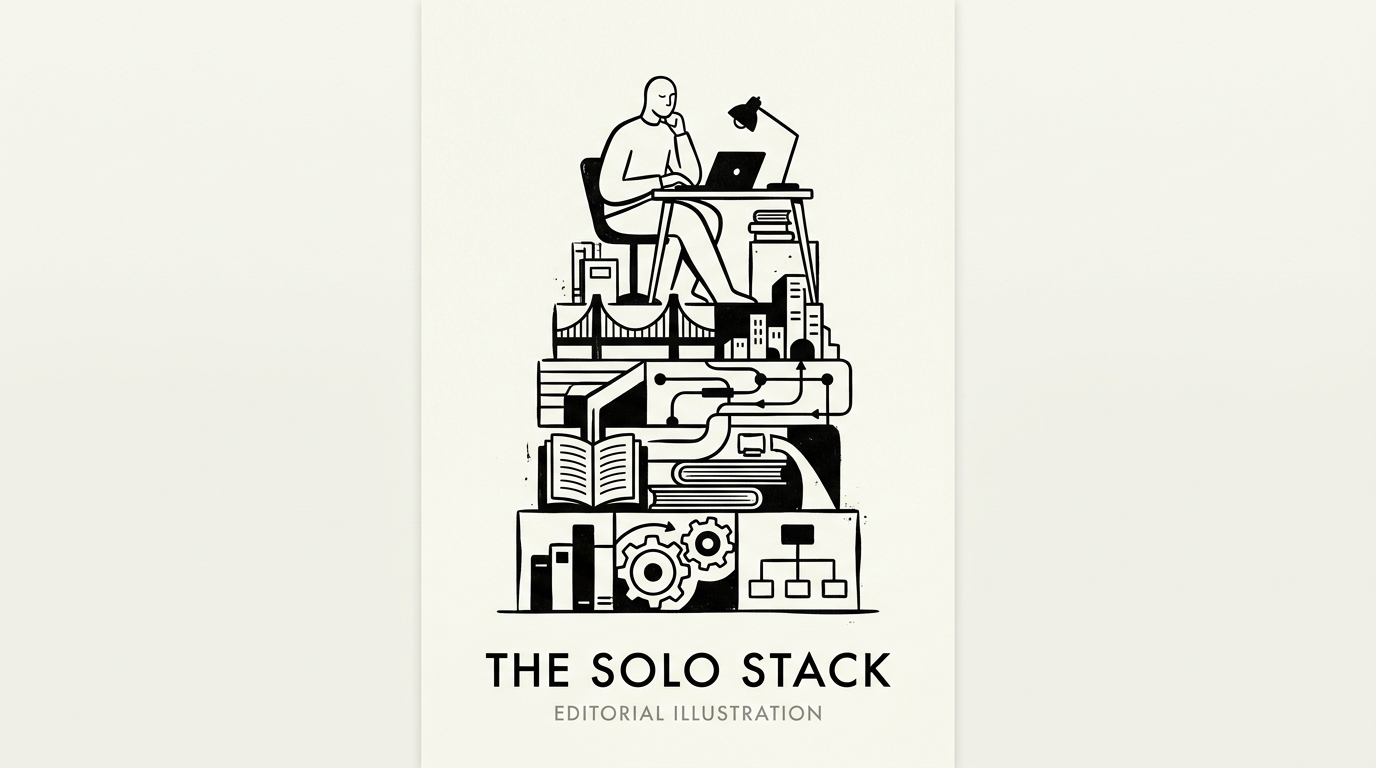
Total Ventures operates on a monthly recurring software spend of $412, a figure that covers the hosting, API credits, and database costs for three distinct product brands. This number is the result of a deliberate architecture designed to solve a specific problem: how one person can maintain multiple software products without the maintenance load becoming a full-time job in itself. When you are the only person in the room, every line of code you write is a future liability, and every new tool you add to the stack is a potential point of failure that you have to fix.
The shift we are seeing in the market isn't about doing more with less; it is about building systems that allow the owner to focus on judgment rather than repetition. In my time as a jazz guitarist and later serving in the Army National Guard, I saw that the most effective performers weren't the ones moving the fastest, but the ones who had the most reliable foundations. In music, it’s a mastery of the changes; in the military, it’s the logistics. In a digital studio, it is the stack.
The Technical Foundation: The Monorepo
I learned the hard way that fragmentation is the primary enemy of the solo operator. In the early days, I would build a new project with whatever framework felt exciting at the moment. Within six months, I’d have four different projects using four different versions of React, different authentication providers, and different styling libraries. When a security patch was needed or a simple UI update had to be rolled out, I had to context-switch four times.
Today, everything I build lives in a single monorepo. This isn't just a folder structure; it is a shared engine. Inky, Pregnancy Power Hour, and The F1 Formula all pull from the same core library of components and logic. If I improve the way a payment is processed in one brand, that improvement is instantly available to the others. This shared infrastructure allows me to maintain a portfolio of products with the same amount of effort it used to take to manage one. The goal is to minimize the "cost of starting." When the rails are already laid, moving from a concept to a shipped product is a matter of days, not months.
The Operational Layer: Agentic Engineering
The most significant change in how I work involves the orchestration of agents. I don't use AI to replace my thinking; I use it to execute the architecture I’ve designed. This is what I call agentic engineering—building a system where autonomous agents handle the high-volume, low-judgment tasks that usually require a junior team.
Within Total Ventures, I built a system called ShadowBrain. It handles the escalation paths. If a server goes down or a customer has a billing issue that fits a known pattern, the system handles it. If the situation requires a decision on brand voice or a complex technical trade-off, it escalates to me. This creates a buffer. It means that when I am spending the morning with my son, Jupiter, the business is still "awake" and operating. The stack isn't just the code that the customer sees; it is the hidden layer of agents that monitor, report, and maintain the health of the studio.
The Financial Rails: Profit-First
Running a studio alone requires a different relationship with money than a traditional startup. I don't look at "runway" because the goal isn't to reach a massive exit; the goal is to build a sustainable, cash-flowing asset. This means the stack must be lean. I avoid "enterprise" solutions that charge per seat or carry heavy monthly minimums.
Instead, I prioritize tools that scale with usage. If a product has zero users this month, the cost should be near zero. If it scales to ten thousand users, the margins should stay healthy. I track three main numbers: my infrastructure cost per user, the time-to-ship for new features, and the monthly profit margin. Revenue is a useful metric for growth, but profit is what buys the freedom to choose what to build next. By keeping the fixed costs low—like that $412 baseline—I can afford to take bets on new products without putting the existing ones at risk.
The Human Element: The Owner’s Rhythm
The final piece of the stack isn't software; it is the schedule. Because I moved out of the country to be fully present for the birth of my son, I had to become incredibly disciplined with my time. I don't have the luxury of "grinding" for fourteen hours a day. My stack has to support a life where the most important work often happens in a three-hour window of deep focus.
This means the tools I choose must be "quiet." I don't want a dashboard that screams at me with notifications. I want a system that provides a clear, calm overview of the studio's health so I can make an informed decision and then step away. The stack is there to serve the life, not the other way around. Whether it is woodworking, playing music, or exploring a new city with Brittany, the business needs to be a machine that runs in the background.
The true value of a solo stack isn't the specific technologies involved—those will change as the industry moves. The value is in the integration. When the technical, operational, and financial layers all point in the same direction, a single person can hold more leverage than a funded team of twenty. The goal isn't to see how much one person can do, but to see how much a well-designed system can hold while the person at the center stays human.
Studio Notes
How I’m building the studio.
The operator’s log — systems, decisions, and what’s working.
Written by
Founder, Total Ventures
Solo-founder building a multi-brand product studio with AI agents. Writing about building, operating, and shipping.