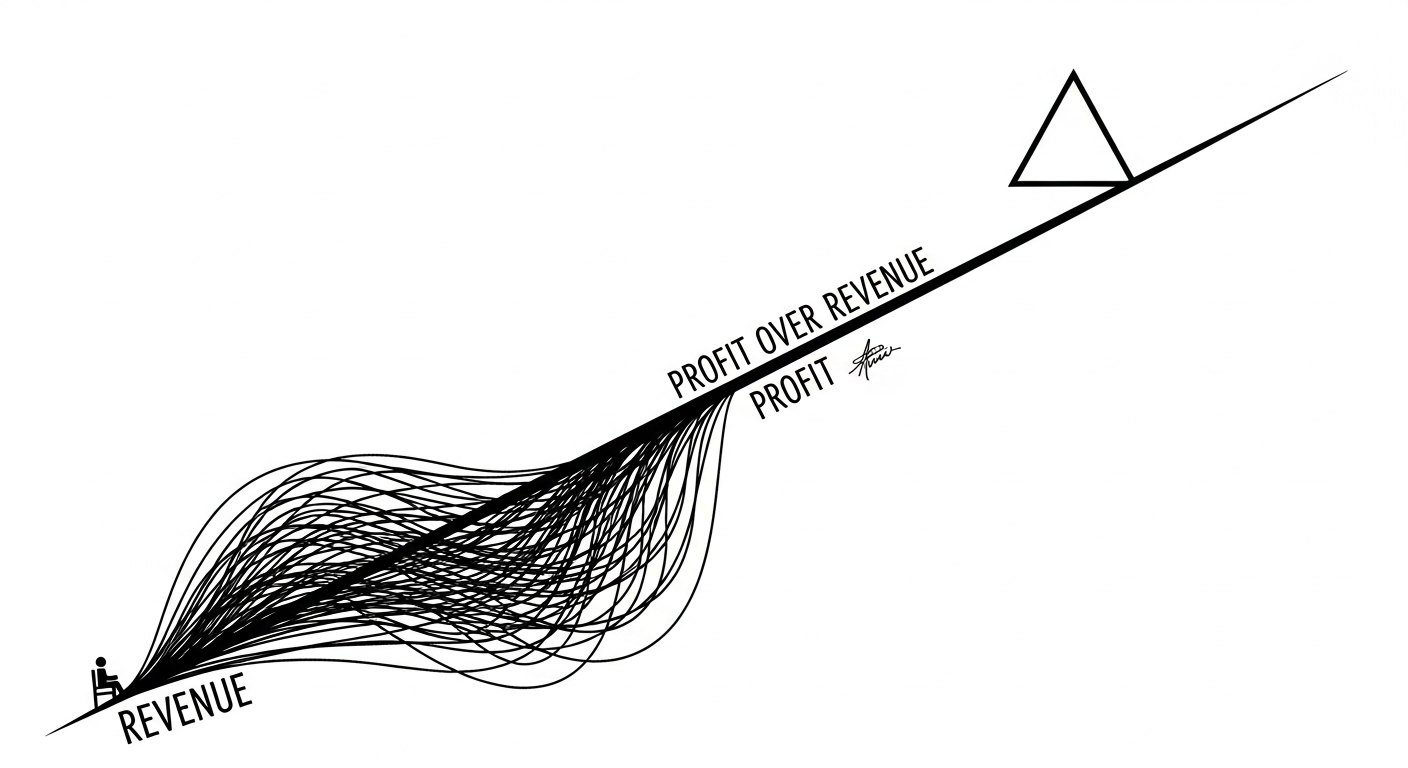
You are looking at two options. The first is a $5,000 custom consulting engagement. The second is a $999 strategy hour. Most founders take the $5,000. They want the screenshot of the Stripe notification to post on social media. They want the prestige of a 'high-ticket' client. But if that $5,000 project requires forty hours of your life, three rounds of revisions, and $2,000 in outsourced labor, you didn't win. You just bought a job with a bad boss.
Profit before revenue means picking offers by margin, not by topline. A $999 strategy hour at 95% margin beats a $5,000 consulting engagement at 30%—both directions, every quarter, until the math is permanent. This is the core of a profit-first architecture for a digital product studio.
The Revenue Mirage
Revenue is a vanity metric. It tells the world how much money passed through your hands, but it says nothing about how much stayed there. In the old model, growth meant hiring. If you hit $1M in revenue, you likely had a team of ten, an office lease, and a mountain of overhead. You were 'successful' by every public standard, yet your take-home pay was often less than a senior engineer at a mid-sized tech firm.
When you operate as a one-person studio, the goal isn't to build a massive organization. The goal is to build a high-margin machine. A profit-first mindset changes how you evaluate every opportunity that hits your inbox. You stop asking 'How much is this worth?' and start asking 'What is the margin on my attention?'
I learned the hard way that high-revenue projects often carry hidden costs that don't show up on a proposal. Meetings, project management, and 'quick syncs' are margin killers. They are the friction that slows down the machine.
The Math of the Owner’s Margin
Let’s look at the numbers.
If you sell a $5,000 service that takes 40 hours to deliver, your gross hourly rate is $125. After you subtract software seats, taxes, and perhaps a contractor to handle the parts you don't want to do, that number drops significantly. More importantly, your capacity is capped. You can only do so many of these before you are out of hours.
Now, consider the $999 strategy hour. It is a productized service. It has a fixed scope, a fixed time commitment, and requires zero prep or follow-up because the system handles the intake and the delivery. At a 95% margin, you keep $949. To match the profit of that $5,000 project, you only need to sell two or three of these.
The difference is the leverage. The strategy hour leaves you with 37 extra hours in your week to build assets that compound. This is how you move from working in the business to working on the business.
Designing for Margin with Agents
In my studio, Total Ventures, I don't have employees. I have an agent workforce. This is the shift that makes a profit-first model viable at scale.
When the cost of building software and managing operations collapses because of AI, the only remaining costs are your judgment and your infrastructure. By using agentic engineering to handle the repetitive tasks—research, initial drafts, monitoring, and deployment—you protect your margin.
An agent doesn't need a 401k or a performance review. It runs the operating system I architected, escalating only the high-consequence decisions to me. This allows the studio to run multiple brands and revenue streams without the overhead of a traditional agency. We aren't just building products; we are building systems that run products.
Building to Keep
When you prioritize profit over revenue, your perspective on the work changes. You stop looking for the next 'gig' and start looking for the next asset.
Every product in the Total Ventures portfolio is built to keep. We aren't looking for an exit or a valuation. We are looking for durable free cash flow. When you own the machine and the machine is high-margin, you don't need to chase the next $50k contract to keep the lights on. You have the breathing room to make better bets.
This discipline is what allows for a life that isn't dictated by a calendar. It means being present for my son, Jupiter, and having the time to think deeply about the next system. If an offer doesn't fit the margin profile, it doesn't get past the gate.
Transitioning to a Profit-First Model
If you are currently chasing six-figure ARR but finding yourself with no cash at the end of the month, it’s time to audit your offers.
- Calculate your true margin. Include the cost of your time at a fair market rate.
- Identify the 'leaky' services. Which projects have the most meetings and the most revisions? These are your lowest-margin assets.
- Productize the high-value pieces. Take the best part of your consulting and turn it into a fixed-price, high-margin offer.
- Automate the delivery. Use agents to handle the heavy lifting so your involvement is limited to high-leverage judgment calls.
Adopting a profit-first strategy is a quiet move. It doesn't always make for the loudest headlines, but it makes for the strongest companies. It’s about the discipline to say no to impressive numbers so you can say yes to a sustainable life.
Always forge ahead.
Studio Notes
How I’m building the studio.
The operator’s log — systems, decisions, and what’s working.
Written by
Founder, Total Ventures
Solo-founder building a multi-brand product studio with AI agents. Writing about building, operating, and shipping.