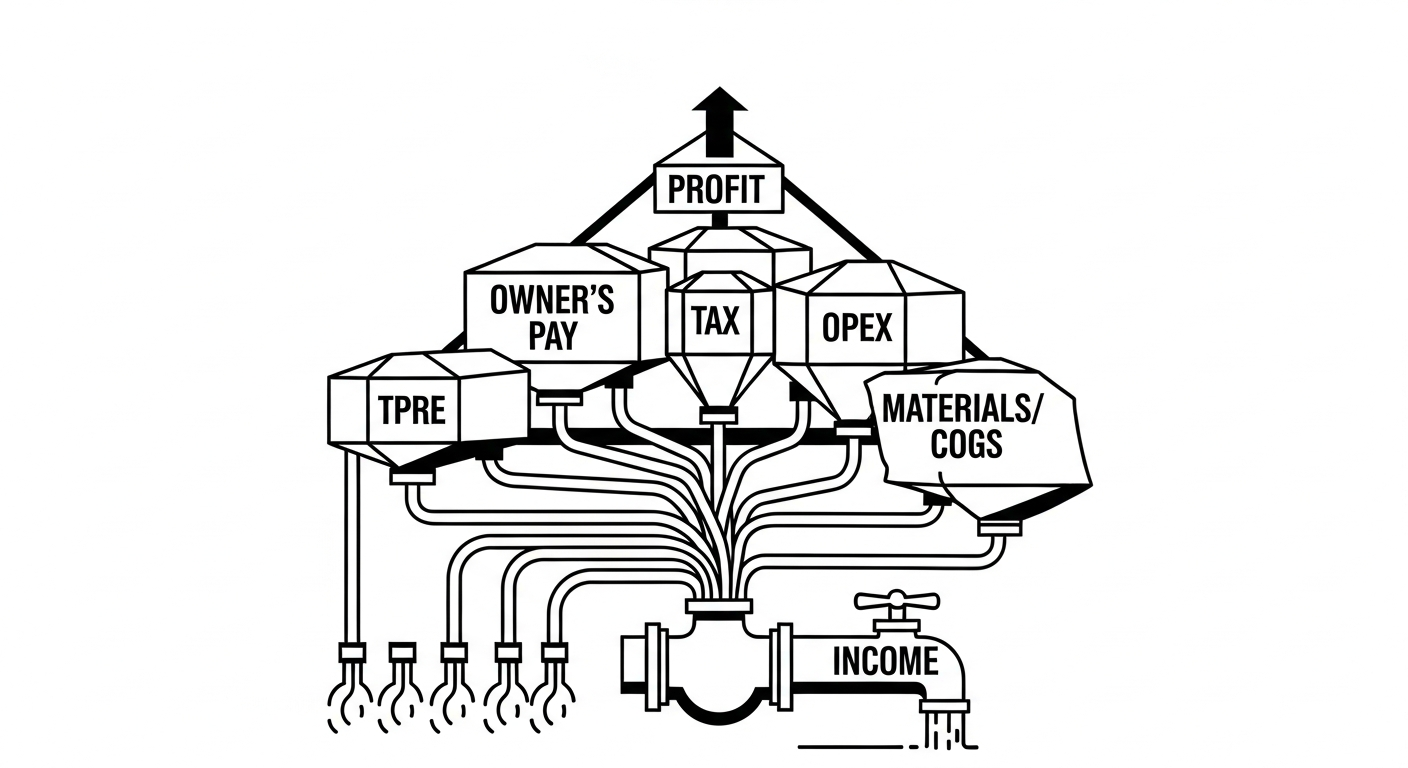
If you've read Profit First, you know the core idea: allocate your revenue into separate accounts for Profit, Owner's Pay, Taxes, and Operating Expenses. It's a powerful mental model for financial discipline. But for many solo founders, the gap between intention and execution is wide. You might have opened those five savings accounts, felt a surge of financial clarity, and then… never actually swept the cash on a consistent schedule. The mechanic that closes this gap, the one that makes Profit First truly work, is a combination of separate Mercury accounts and a daily categorization cron that tags every transaction the same day it lands.
The Profit First Promise vs. The Solo Founder Reality
The promise of Profit First is simple: by pre-allocating funds, you ensure that profit isn't an afterthought, but a deliberate choice. You pay yourself, you set aside for taxes, and you operate within what's left. This forces lean operations and builds a healthy financial foundation. For a small business with a bookkeeper and a clear weekly or bi-weekly sweep, it's straightforward.
But for the solo founder, especially one running an agentic operation like Total Ventures, the reality is often different. You're wearing all the hats. The mental load of remembering to log into multiple bank accounts, calculate percentages, and manually transfer funds can feel like another chore on an already overflowing to-do list. Revenue comes in, expenses go out, and before you know it, the money is all in one place, blurring the lines you so carefully drew.
This isn't a failure of understanding; it's a failure of system design. The manual effort required to maintain the Profit First system often exceeds the available time and attention of a single operator.
Why Separate Accounts Are Non-Negotiable
The core of Profit First isn't just mental accounting; it's physical separation. Having distinct bank accounts for each allocation category is crucial. It creates a clear visual and functional barrier between your funds. When you look at your Profit account, you see profit. When you look at your Tax account, you see your tax liability building up.
For Total Ventures, I use Mercury for this. Their interface is clean, and setting up multiple sub-accounts is seamless. I have a primary operating account, and then separate accounts for:
- Profit: The ultimate goal, the reward for building something valuable.
- Owner's Pay: My salary, distinct from profit distributions.
- Tax: Funds set aside for quarterly estimated taxes.
- Operating Expenses: The budget for running the business day-to-day.
This physical separation is the first, non-negotiable step. Without it, the system remains theoretical. With it, you create the infrastructure for true cash flow management.
The Missing Link: Automated Categorization and Sweeps
Having the accounts is one thing; moving the money is another. This is where automation becomes critical for the solo operator. My solution involves a daily cron job that categorizes every transaction and then, on a set schedule, initiates the sweeps.
Here's how it works:
1. The Categorize Cron
Every day, an AI agent runs a script that pulls all new transactions from my Mercury accounts. It then categorizes each transaction based on predefined rules. For example:
- Incoming revenue from product sales goes to the Operating Expenses account initially.
- Software subscriptions are tagged as 'SaaS'.
- Marketing spend is tagged as 'Marketing'.
This daily categorization is vital. It ensures that by the time I review my finances, everything is already sorted. It removes the manual drudgery of going through bank statements and assigning categories, which is often the first point of failure for solo founders trying to implement Profit First.
2. The Sweep Schedule
Once a week, or bi-weekly depending on revenue flow, another automated process kicks in. This is the actual Profit First sweep. It calculates the predetermined percentages for Profit, Owner's Pay, and Tax based on the revenue that has landed in the Operating Expenses account since the last sweep. Then, it automatically transfers those funds to their respective dedicated accounts.
For example, if my allocation percentages are 10% Profit, 30% Owner's Pay, and 15% Tax, and $10,000 in revenue has come in:
- $1,000 moves to the Profit account.
- $3,000 moves to the Owner's Pay account.
- $1,500 moves to the Tax account.
The remaining $4,500 stays in the Operating Expenses account for day-to-day costs. This automated sweep ensures that the allocations happen consistently, without me needing to remember or manually initiate them. It's the machine doing the work of a financial assistant.
The Benefits of an Agentic Profit First System
Implementing Profit First with this level of automation offers several key advantages for the solo founder:
- Consistency: The sweeps happen on schedule, every time, without fail. No more missed allocations or backlogs.
- Clarity: Your account balances accurately reflect your financial position for each category. You always know how much profit you've truly set aside, how much you have for taxes, and your real operating budget.
- Reduced Mental Load: You're freed from the tedious task of manual categorization and transfers. Your attention can remain on building and operating your products.
- Forced Discipline: The system enforces the Profit First principles. You're less likely to overspend on operating expenses when you see the other accounts growing with their allocated funds.
This approach transforms Profit First from a good idea into an operational reality. It's not just about knowing where your money should go; it's about building a system that makes it go there, consistently and automatically.
Building Your Own Automated System
While the specific implementation details will vary based on your banking platform and technical comfort, the principles remain the same:
- Dedicated Accounts: Use a bank that allows easy creation of multiple sub-accounts (like Mercury).
- API Access: Look for banking platforms with robust APIs that allow programmatic access to transactions and transfers. This is crucial for automation.
- Automation Layer: Whether it's a simple cron job running Python scripts, a no-code automation tool, or a custom agent, you need something to execute the categorization and sweeps.
This isn't just about saving time; it's about building a resilient financial backbone for your business. It's about ensuring that as a solo operator, you can leverage the power of agentic engineering to manage your finances with the same rigor as a larger team, without the overhead.
What financial systems have you automated in your business?
Studio Notes
How I’m building the studio.
The operator’s log — systems, decisions, and what’s working.
Written by
Founder, Total Ventures
Solo-founder building a multi-brand product studio with AI agents. Writing about building, operating, and shipping.