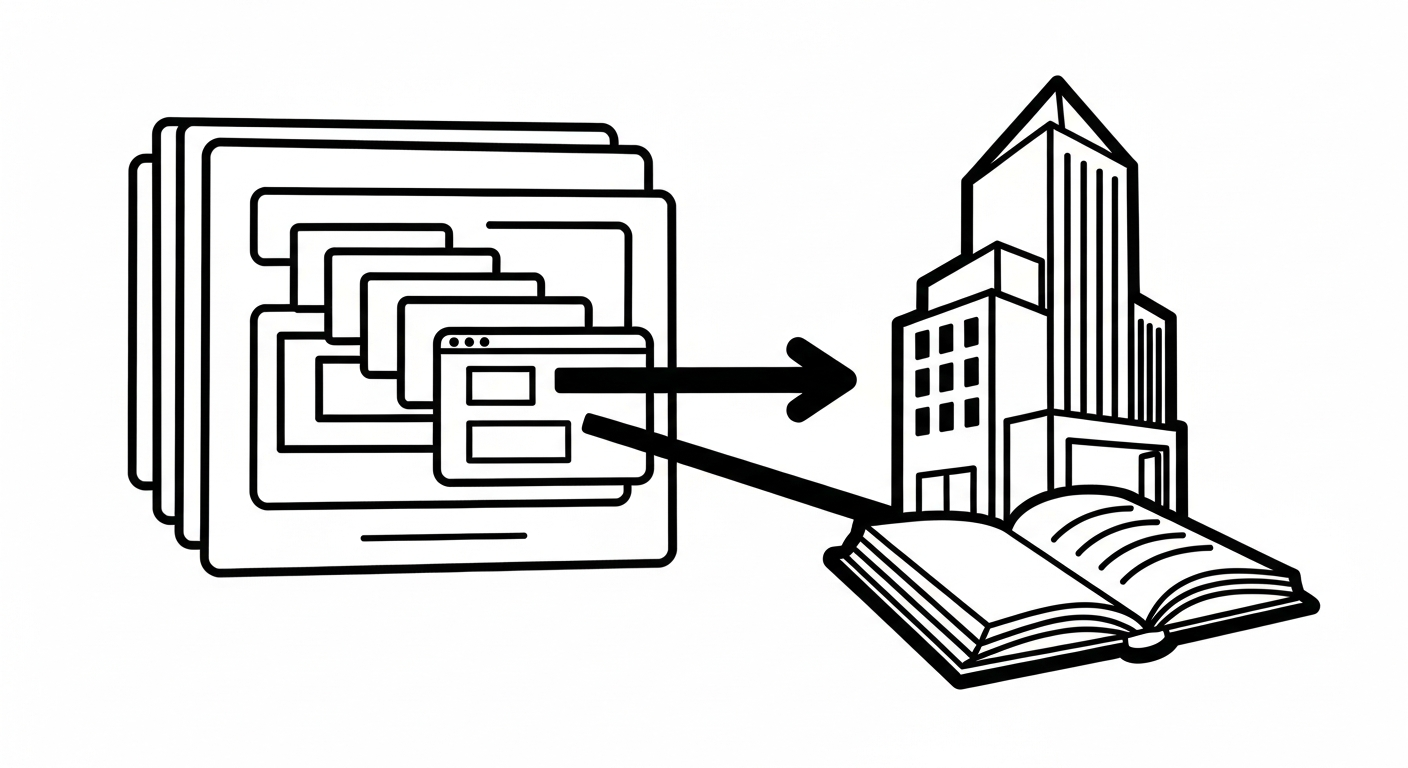
You are told that making a career change into tech is a reset. You are told to start at the bottom, collect credentials, and wait for permission to build. This is incorrect. A career change into tech is not a restart; it is a migration of your existing operating system into a new dialect.
I have run logistics for the Army National Guard, managed jazz ensembles, handled operations for real estate teams closing millions, and produced Super Bowl commercials. On paper, these look like disconnected pivots. In practice, they are the same system expressed through different mediums. Whether you are moving equipment across a state or moving data across a network, the underlying logic of systems, dependencies, and feedback loops remains constant.
The Operating System vs. The Dialect
Most people fail their career change into tech because they focus on the syntax instead of the system. They spend months trying to become an "expert" in a specific framework, forgetting that the framework is just a tool.
If you come from a non-CS background, your advantage is your domain-specific operating system.
Logistics is State Management
In the Army, logistics is about knowing where every asset is, where it needs to go, and what happens if the bridge is out. In software, this is state management. If you can manage a supply chain, you can manage a Redux store or a database schema. The medium is digital, but the logic of "if this, then that" is identical.
Music is Concurrent Processing
As a musician, you are managing multiple streams of information in real-time—tempo, harmony, dynamics, and the physical mechanics of the instrument. This is concurrent processing. If you can play in a jazz quartet, you already understand how independent actors must synchronize to produce a coherent output. Code is just a slower, more persistent version of a score.
Operations is Error Handling
If you have run a real estate ops team or a production set, you know that things break. You build redundancies. You create protocols for when the primary plan fails. This is error handling and site reliability engineering. You have been doing this for years; you just haven't been doing it in a code editor yet.
Shipping Today: Why Artifacts Beat Credentials
I learned the hard way that the market does not care about your certificates. It cares about what you have shipped. When you are navigating a career change into tech, your goal is to produce artifacts that prove your ability to architect systems.
Do not build another generic weather app or a clone of a social media site. Build a system that solves a specific problem from your previous career. If you were in healthcare, build a tool that automates a specific compliance check. If you were in retail, build a system that optimizes inventory based on local weather patterns.
Working in public is the only way to bridge the gap between where you are and where you want to be. Post the commit, share the architectural diagram, and explain why you made the trade-offs you did. The goal is to show that you are an architect of systems, not just someone who can follow a tutorial.
Agentic Engineering: The New Team
In the current landscape, you are not just a developer. You are an operator running a studio. With the advent of agentic engineering, the barrier to entry for non-CS builders has shifted. You no longer need a team of twenty to ship a complex product. You need a system that leverages AI as the operating layer.
In my studio, I use AI to handle the heavy lifting—research, boilerplate, infrastructure monitoring, and initial drafts of complex functions. This allows me to focus on the architecture. As someone making a career change into tech, you should not be competing on how fast you can type syntax. You should be competing on how well you can orchestrate agents to build the system you’ve designed.
This is not about "AI replacing developers." It is about AI amplifying the builder. If you can define the requirements and understand the system architecture, the AI becomes your engineering team. This is how a solo operator out-ships a legacy department.
The Reality of the Transition
There is no secret path. There is only the work. I have spent years building across mediums, and the most important lesson I’ve learned is that the craft is the credential.
Stop apologizing for your non-traditional background. Your background is your edge. A developer who only knows code is a commodity. A builder who knows how to run a logistics operation and can architect a system to automate it is a force.
Focus on the following:
- Identify the system: What is the underlying logic of your current work?
- Learn the dialect: Pick a stack and learn enough to express that logic.
- Ship the artifact: Build something real that solves a problem.
- Iterate in public: Show the work, the breaks, and the fixes.
Your career change into tech is complete when you stop seeing yourself as a student and start seeing yourself as an architect. The tools will change, the languages will evolve, but the ability to build a durable system is a permanent skill.
If you are currently building a system and want to discuss the architecture, I am happy to talk.
Work through this in a 1:1 strategy session through Total Ventures — totalventures.io/booking
Studio Notes
How I’m building the studio.
The operator’s log — systems, decisions, and what’s working.
Written by
Founder, Total Ventures
Solo-founder building a multi-brand product studio with AI agents. Writing about building, operating, and shipping.

