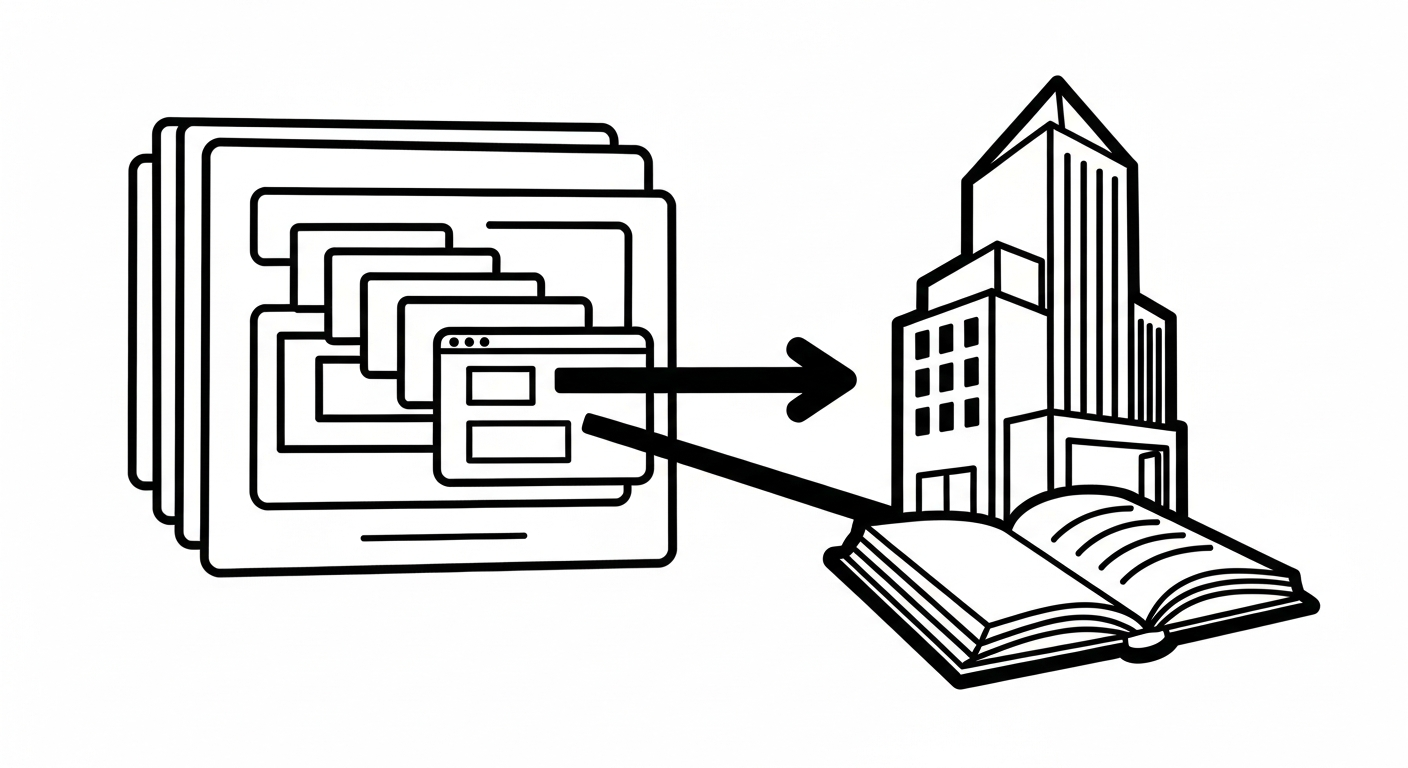
Most advice regarding a career change into tech focuses on the wrong variable. You are told to pick a stack, find a mentor, and grind through LeetCode until someone gives you a permission slip to build. This is the slow way. It treats your previous life as a sunk cost rather than an asset.
I learned the hard way that software is just another dialect for systems I had already been building for a decade. Whether you are coming from music, military logistics, or real estate operations, you aren't starting from zero. You are porting an operating system from one medium to another.
The Myth of the Clean Break
When people discuss a career change into tech, they often frame it as a pivot—a sharp turn away from the past. My experience was different. I ran a music business at nineteen, managed logistics as a Senior NCO in the Army National Guard, and handled operations for a real estate team closing millions in volume.
On the surface, these look like unrelated chapters. Under the hood, they are the same skill set.
Music has grammar and architecture. You are managing tension, release, and frequency. Logistics is state management—moving objects from point A to point B while accounting for latency and resource constraints. Real estate operations is a series of feedback loops and conditional logic.
If you can navigate a complex supply chain or compose a melody, you can architect a system. The syntax of a programming language is the easiest part to learn; the ability to see the system underneath the noise is what actually matters. I stopped viewing myself as someone trying to enter a new field and started seeing myself as a builder who was simply changing tools.
Shipping Today Over Credentialing Tomorrow
One of the biggest traps in a career change into tech is the pursuit of credentials. You do not need a computer science degree to be an architect of systems. You need artifacts.
I didn't get my first roles by showing a certificate. I got them by showing what I was shipping today. When I was tasked with an eight-thousand-SKU e-commerce relaunch, I didn't talk about my potential; I built the system that handled the data migration and the inventory logic.
If you want to move into this space, stop asking for permission. Build a tool that solves a specific problem in the industry you are leaving. If you are in logistics, build a dashboard that tracks transit times. If you are in music, build a tool that manages royalty splits.
Working in public is the only credential that carries weight in the long run. A GitHub repository with a history of commits tells a more compelling story than a line item on a resume. It shows you can handle the friction of building, the inevitability of things breaking, and the discipline required to fix them.
Agentic Engineering: The New Leverage
We are currently in a shift where the traditional path of the junior developer is being rewritten. In my studio, I don't run a team of humans; I run a multi-product studio with AI as the team. This is what I call agentic engineering.
For someone currently navigating a career change into tech, this is your greatest advantage. You no longer need to spend three years mastering the minutiae of a specific framework before you can be productive. You can use AI as an operating layer to handle the boilerplate, the research, and the initial scaffolding.
This doesn't mean the work is easier; it means the work has shifted from syntax to architecture. You need to know how to prompt, how to verify, and how to integrate. You are the architect of the system, and the AI is the crew. I use a custom agent orchestration layer to handle everything from monitoring to deployment. This allows a solo operator to have the output of a full engineering department.
The Logistics of the Transition
When I moved from frontend work at Fender to running my own studio, the transition wasn't about learning a new language. It was about scaling my ability to ship.
Here is what that looks like in practice:
- Identify the Pattern: Look at your current non-tech role. Where is the logic? Where are the bottlenecks? That is your first software project.
- Build the Monorepo: Don't overcomplicate your stack. Pick tools that allow you to move fast and stay lean. I prioritize profit before revenue and craft before scale.
- Learn the Hard Way: You will break things. You will misconfigure a database or blow up a deployment. This is the only way the knowledge sticks. Documentation is a map, but the territory is the code you actually write.
- Show the Artifact: When you talk to potential partners or employers, don't lead with your years of experience. Lead with the before/after. "I migrated 14 callables and shaved 300ms off cold start" is a statement of fact that requires no further credentialing.
The Builder-First Mindset
Software is not a destination; it is a medium. Whether I am building a backend in the morning or a melody in the evening, the impulse is the same. I am building a system that performs a function.
If you are coming from a non-traditional background, do not apologize for your path. The Army taught me more about operational resilience than any coding bootcamp ever could. The music business taught me more about user experience and emotional resonance than a UI/UX course.
Your background is not a hurdle; it is your edge. It allows you to see patterns that someone who has only ever looked at a screen will miss.
I am happy to talk to anyone who is currently in the middle of this transition. The world doesn't need more people who can recite documentation; it needs more builders who can ship real products that solve real problems.
Start building today. The system is waiting for you to architect it.
Happy to talk.
Justin Tsugranes
Studio Notes
How I’m building the studio.
The operator’s log — systems, decisions, and what’s working.
Written by
Founder, Total Ventures
Solo-founder building a multi-brand product studio with AI agents. Writing about building, operating, and shipping.

