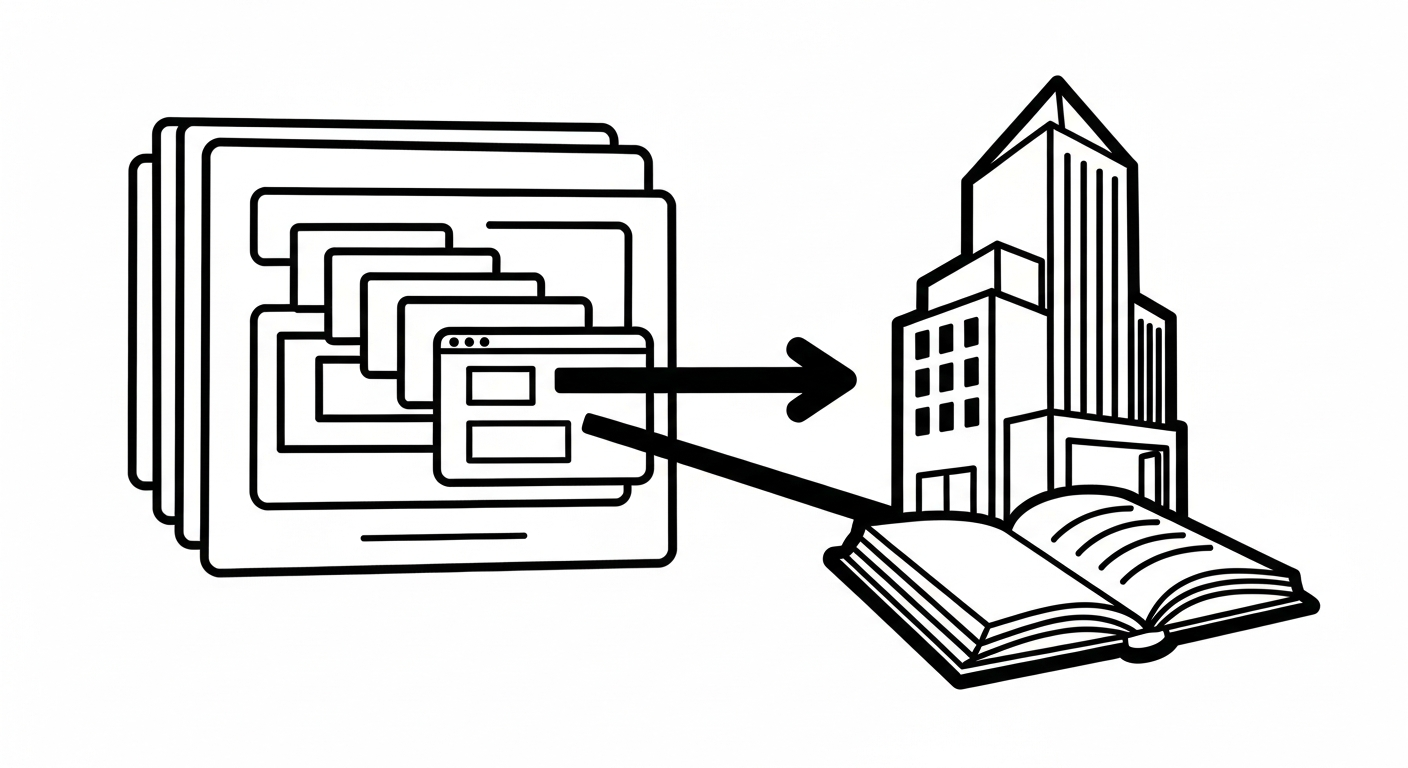
Most people treat a career change into tech like a factory reset. They assume their previous decade in logistics, music, or retail is dead weight—a sunk cost they have to apologize for in interviews.
I learned the hard way that this is the wrong way to frame the transition.
I didn’t start in a computer science lab. I started in jazz clubs at nineteen, moved into Army National Guard logistics, managed real estate operations, and worked on Super Bowl commercial productions. Today, I run a multi-product studio where AI serves as the team. On paper, these look like pivots. In practice, they are the same skill: architecting systems to achieve a specific outcome.
If you are navigating a career change into tech, you aren't starting from zero. You are porting an existing operating system to a new dialect.
The Myth of the Clean Break
The industry loves the narrative of the 'self-taught developer' who spent six months in a basement and emerged as a software engineer. This narrative is a distraction. It focuses on the syntax—the Python, the TypeScript, the React—rather than the logic.
Syntax is a commodity. Logic is the asset.
When I was running logistics for the Army, I was managing state. I had assets (data), locations (memory addresses), and movement orders (functions). If the movement order was flawed, the asset didn't arrive. When I moved into software, the medium changed from trucks to packets, but the underlying system remained the same.
Your career change into tech should be an accumulation, not a replacement. If you’ve managed a kitchen, you understand concurrency and resource contention. If you’ve taught a classroom, you understand documentation and user onboarding. These aren't 'soft skills'—they are the architectural foundations of good software.
Shipping Today Beats Credentialing Tomorrow
The biggest mistake I see career changers make is hiding behind certifications. They spend a year collecting badges from online platforms because they feel like 'just a developer' without a CS degree.
I don't care about your badges. I care about what you’ve shipped.
In my studio, the work credentials the builder. I look for the artifact—the working repo, the deployed app, the automated workflow that solves a real problem. Shipping today is the only way to validate that your logic holds up under pressure.
When you work in public, you expose your thinking. You show how you handle edge cases and how you refactor when things break. This is how you earn your seat. The market doesn't need more people who can pass a multiple-choice test on syntax; it needs builders who can ship a backend in the morning and a melody in the evening because they see the pattern underneath both.
Agentic Engineering: The New Entry Point
The landscape for a career change into tech has shifted. We are no longer in the era of manual boilerplate. In my studio, I use agentic engineering to handle the heavy lifting of research, monitoring, and infrastructure.
This is an advantage for the career changer with domain expertise. If you understand the business logic of healthcare, finance, or construction, you can now use AI as your operating layer to bridge the technical gap. You become the architect of the system, directing agents to execute the syntax while you maintain the integrity of the product.
I don't spend my days fighting with CSS selectors. I spend my days architecting the flow of data between services. AI is the team that allows a solo operator to function like a full-scale agency. If you are entering the field now, your value isn't in how fast you can type; it's in how well you can define the system.
The Artifact-First Approach
If you want to make the transition, stop studying and start building. Pick a problem from your previous career—something that was broken, manual, or slow—and build the solution.
- Identify the System: What was the input, the transformation, and the output?
- Choose the Instrument: Don't worry about the 'best' stack. Pick the one that lets you ship the fastest.
- Build the MVP: Get the core logic working.
- Document the 'Why': Explain the trade-offs you made. This is where your experience shows.
I’ve built eight-thousand-SKU e-commerce platforms and simple internal tools. The scale changes, but the requirement for a stable, predictable system does not.
Moving Forward
A career change into tech is not a move toward a 'easier' or 'cooler' job. It is a commitment to a lifetime of learning the hard way. It requires a dry, builder-first mentality. You will break things. You will ship bugs. You will realize that the 'perfect' architecture you planned on Monday is useless by Wednesday.
That is the work.
I’m not interested in hype or the latest 'paradigm shift.' I’m interested in what works. If you are building something real and want to talk about the systems behind it, I’m happy to talk.
Your previous experience is not a liability. It is your competitive edge. Use it to build something that lasts.
Next Step: Audit your last three years of work. Identify one manual process that could be automated with a simple script or agentic workflow. Build it this week and document the result.
Studio Notes
How I’m building the studio.
The operator’s log — systems, decisions, and what’s working.
Written by
Founder, Total Ventures
Solo-founder building a multi-brand product studio with AI agents. Writing about building, operating, and shipping.


