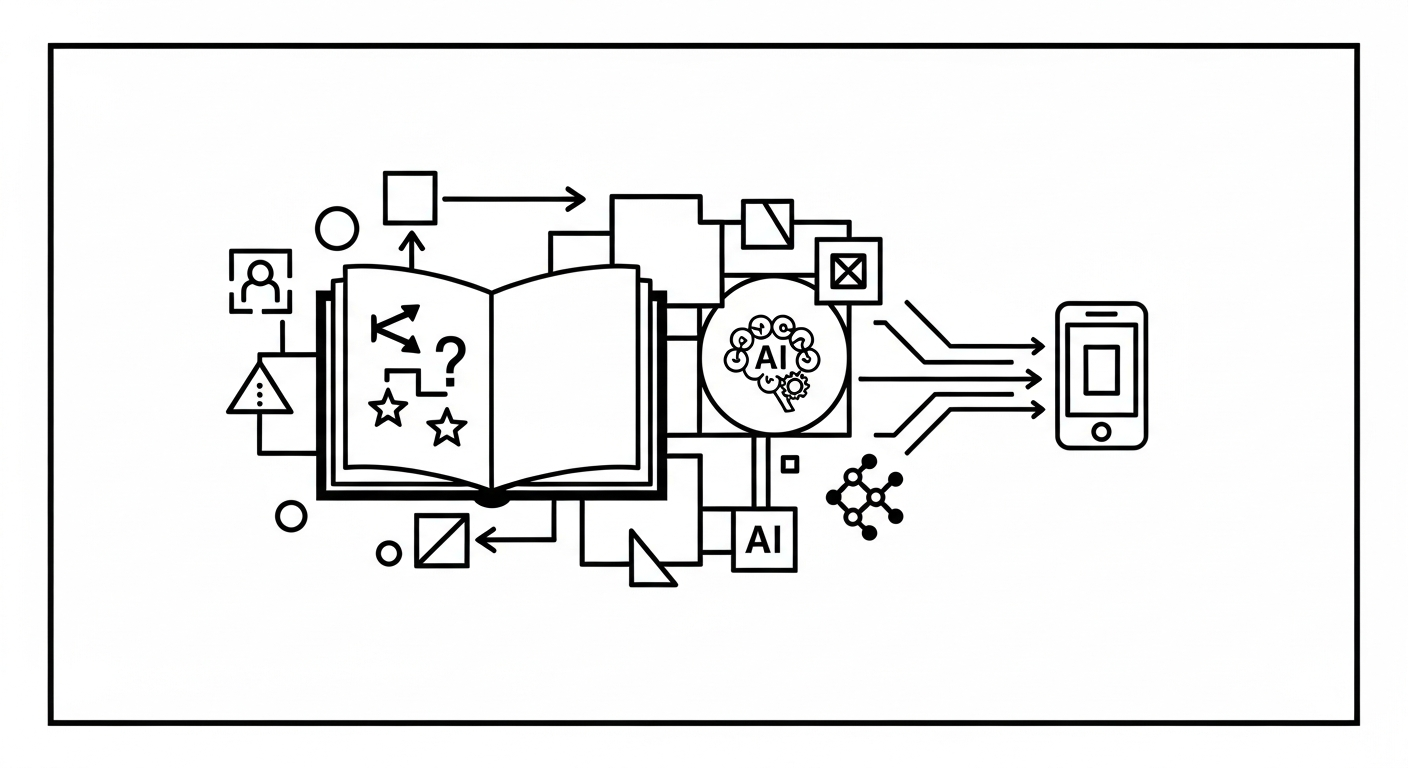
I am shipping Inky today. It is not a wrapper, and it is not a weekend experiment. It is a digital product built within a multi-product studio where AI functions as the operating layer rather than just a tool for autocomplete.
When you start building an ai story app, the temptation is to focus on the prompt. You think the value lies in the specific sequence of words you send to an LLM to generate a narrative. This is a mistake. The prompt is a commodity. The value is in the system architecture—the way you manage state, handle context windows, and orchestrate agents to ensure the story remains coherent over ten thousand words instead of two hundred.
This is what I have learned the hard way while architecting Inky.
The System Behind the Story
Most people approaching this space see a linear path: User Input -> LLM -> Output. In a production environment, that path is brittle. It breaks the moment the user wants to backtrack, branch a narrative, or maintain a complex world-state that exceeds the immediate context window of the model.
In building Inky, I treated the application as a series of feedback loops. I am not an author of one stack; I am an architect of systems. The stack for Inky involves a monorepo structure that allows me to share types and logic between the core engine and the delivery layers. I use Claude API for the heavy lifting of narrative synthesis and Gemini for high-throughput, low-latency world-building tasks.
The operating layer is VERA—the custom agent orchestration layer I built for my studio. VERA handles the background tasks that a human team would normally manage: consistency checks, character arc tracking, and metadata generation. When you are building an ai story app, you are actually building a small, automated publishing house.
Agentic Engineering in Practice
I use the term agentic engineering to describe how this studio functions. It means I am not just writing code; I am designing agents that write, test, and monitor code. For Inky, this meant building a 'Narrative Architect' agent.
This agent doesn't write the story. It maintains the 'Source of Truth'—a structured JSON object that tracks every character's current location, emotional state, and known facts. Before the 'Writer' agent generates a single sentence, the Architect validates the state. If the Writer tries to put a character in two places at once, the system catches it before the user ever sees the output.
This is how you move from a toy to a product. You stop relying on the model to 'remember' and start building external memory systems that the model can query.
Managing State and Context
One of the primary hurdles in building an ai story app is the decay of coherence. LLMs are probabilistic; they drift. If you ask an AI to write a story for an hour, by minute forty, it has forgotten the color of the protagonist's eyes or the stakes established in the first chapter.
I solved this by implementing a recursive summarization loop. Every three 'beats' of the story, an agent analyzes the new content, extracts the essential plot points, and updates the global state. This state is then injected into the system prompt for the next beat.
We are not just sending a long string of text; we are sending a compressed, high-density map of the story so far. This keeps the narrative tight and the latency low. I learned the hard way that trying to pass the entire raw history into the context window is a recipe for both high costs and 'hallucinated' endings.
The Money Layer: Profit Before Hype
I run this studio on a profit-first basis. Revenue is a vanity metric; cash flow and durability are what matter. When building an ai story app, your biggest risk is the API bill.
If your architecture is inefficient, your margins disappear as your user base grows. I engineered Inky to use tiered modeling. We use smaller, faster models for routine tasks like grammar checking or formatting, and reserve the high-parameter models for the creative synthesis.
By offloading 70% of the token volume to more efficient models, I reduced the operating cost per story by nearly 60%. This isn't about being cheap; it's about building a business that can survive without a venture capital infusion. I build small, well-run, and durable.
Lessons Learned the Hard Way
- The UI is the bottleneck. Users don't want to wait thirty seconds for a generation. I had to implement streaming responses and optimistic UI updates to make the experience feel instantaneous, even when the backend was doing heavy lifting.
- Prompt versioning is mandatory. A 'small' tweak to a prompt can have cascading effects on the narrative structure. I now treat prompts like code—they are versioned, tested against a baseline, and rolled back if they degrade the output.
- AI is the team, not the product. The product is the story. The AI is just the most efficient way to produce it at scale. If you lead with 'AI-powered,' you are selling the engine. I prefer to sell the ride.
Working in Public
I am building this studio out in the open because the patterns I am finding in software apply to everything else I’ve done—from Army logistics to music production. It is all just systems and feedback loops.
Inky is one expression of this operating model. The goal isn't to build one 'hit' app; it's to build a system that can ship ten of them a year with a team of one and an operating layer of many.
If you are currently architecting your own systems or looking to move from 'prompting' to 'engineering,' I have documented the specific frameworks I use to keep the studio lean.
Full implementation details and the logic behind my agentic workflows are available in The Builder's Playbook — totalventures.io/resources/builders-playbook
Happy to talk.
Justin Tsugranes
Studio Notes
How I’m building the studio.
The operator’s log — systems, decisions, and what’s working.
Written by
Founder, Total Ventures
Solo-founder building a multi-brand product studio with AI agents. Writing about building, operating, and shipping.


