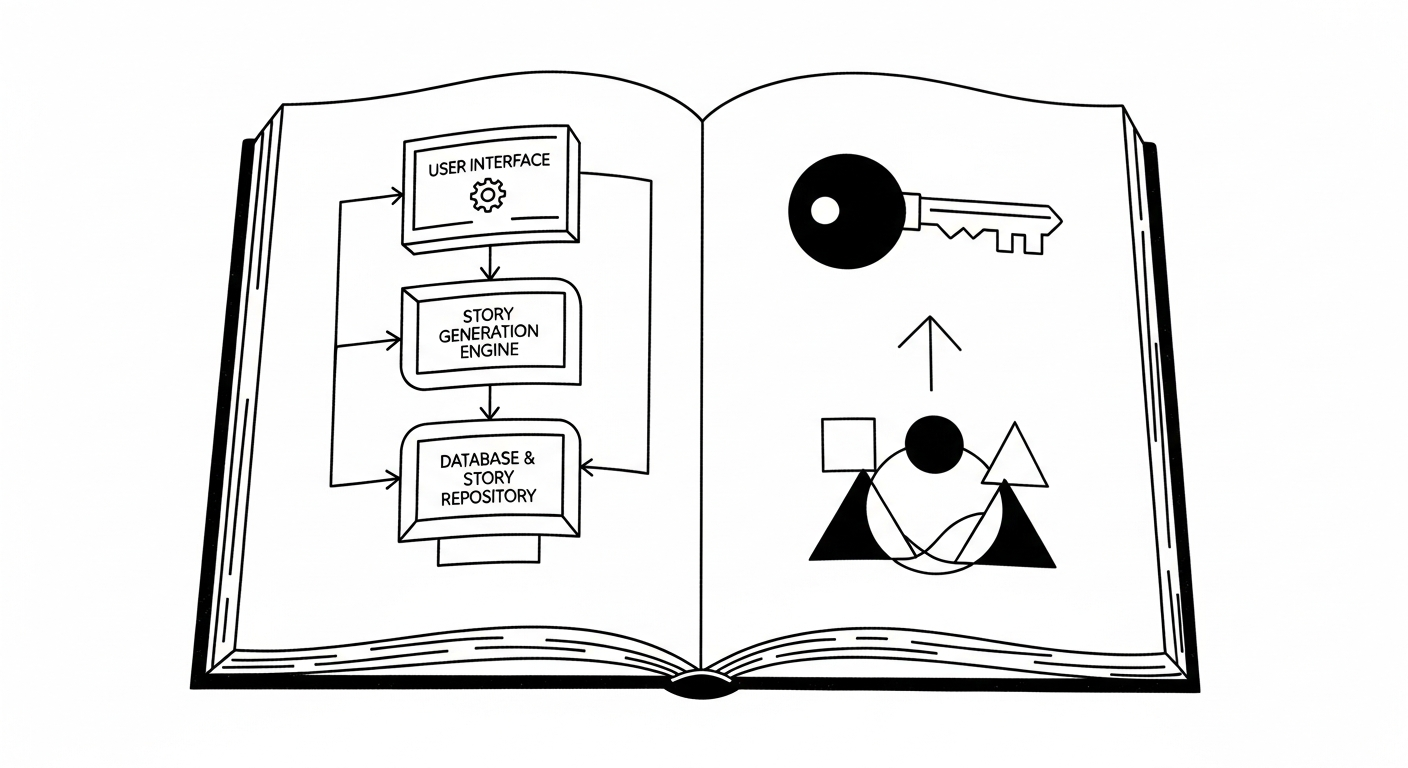
I am shipping today. The product is Inky, an AI-native storytelling application. It is the latest addition to the Total Ventures portfolio, and it represents a specific thesis on how software is built and kept in the current era.
Building an ai story app is no longer a matter of basic CRUD operations. It is a matter of designing a system where AI is the workforce and the human is the architect. This post outlines the decisions made, the lessons learned the hard way, and the architecture required to run a product with zero employees.
The Thesis Behind Inky
The cost of generating content has collapsed. In the old model, a storytelling app required a massive library of pre-written content or a community of creators. Today, the value has shifted from the content itself to the system that orchestrates its creation, the taste that guides it, and the interface that delivers it.
When I began building an ai story app, I didn't look at it as a temporary experiment. Total Ventures is a permanent-equity company. We build to keep. This means every architectural choice must favor durability and maintainability over the long term. If a system requires constant manual intervention, it is a liability, not an asset.
Inky is designed to be an autonomous property. It uses agentic engineering to handle the heavy lifting of narrative construction, character consistency, and world-building. My role is to manage the machine, not to write the stories.
Agentic Engineering in Practice
The workforce for Inky consists of specialized agents. I have moved away from the idea of a single, monolithic prompt. Instead, the architecture relies on a series of discrete agents, each with a specific job description within the narrative pipeline.
One agent is responsible for the structural integrity of the plot. Another manages the emotional arc of the characters. A third handles the stylistic polish of the prose. These agents interact through a shared orchestration layer that I built to ensure they don't drift away from the core user intent.
This is agentic engineering. It is the process of building a system where the AI doesn't just respond to a user; it works through a multi-step process to achieve a high-quality result. By breaking the work down into smaller, verifiable steps, I can ensure the output meets the standards of a premium product.
Managing Narrative State and Context
The primary technical challenge in building an ai story app is context management. Large language models have limits. If you ask a model to write a ten-chapter story in one go, the quality will degrade by chapter three. The characters will forget their motivations, and the plot will lose its thread.
I learned the hard way that you cannot rely on the model's memory alone. You must build an external state management system. In Inky, the narrative state is stored in a relational database. Every character trait, every plot point, and every piece of world-building is indexed and retrieved as needed.
When the drafting agent begins a new chapter, the orchestration layer fetches the relevant context from the database and injects it into the prompt. This ensures that a character who was wearing a blue coat in chapter one isn't suddenly wearing a red one in chapter five. It is a deterministic solution to a non-deterministic problem.
Built to Keep: The Permanent Equity Model
Most people building in this space are looking for a quick exit. They want to flip a project before the next model update renders their wrapper obsolete. Total Ventures operates differently. We build digital products to hold them forever.
This long-term horizon changes how I approach the business side of building an ai story app. I am not chasing vanity metrics. I am focused on durable free cash flow. This means:
- Unit Economics: I track the cost per story generation with precision. If the margins don't work at scale, the product doesn't ship.
- System Moats: The moat isn't the AI model; it's the proprietary data layer and the orchestration logic that makes the model useful.
- Operational Efficiency: The goal is a product that runs itself. I spend my time on the businesses, not in them.
By treating Inky as a permanent asset, I am forced to build with a level of discipline that a temporary project doesn't require. The code is clean, the infrastructure is robust, and the financial rails are transparent.
Lessons Learned the Hard Way
Early in the development of Inky, I tried to automate too much of the creative direction. I thought the agents could handle the high-level 'taste' decisions. I was wrong. The result was technically proficient but emotionally flat.
I realized that the human face of the machine is still necessary. The AI is the workforce, but I am the owner. I had to redesign the system to allow for human-in-the-loop checkpoints at the most critical narrative junctions. This didn't slow down the process; it improved the product.
Another lesson was the importance of a unified monorepo. When you are running multiple brands with a small team—or no team—you cannot afford to manage fragmented codebases. Every product in the Total Ventures portfolio, including Inky, shares a common engine. Improvements to the orchestration layer in one product benefit all of them. This is how one person can operate a portfolio of AI-native products without burning out.
Shipping Today
Inky is live. It is a demonstration of what is possible when you combine agentic engineering with a permanent-equity mindset. It is not a side project; it is a cash-flowing property built to last.
Building an ai story app has reinforced my belief that the future belongs to the operators who can design and manage these machines. The cost of building has collapsed, but the value of judgment and system design has never been higher.
I am happy to talk about the architecture or the operating model behind Total Ventures. If you are looking to move from being a developer to being an owner, the path is clear: build systems, not just features.
Work through this in a 1:1 strategy session through Total Ventures — totalventures.io/booking
Studio Notes
How I’m building the studio.
The operator’s log — systems, decisions, and what’s working.
Written by
Founder, Total Ventures
Solo-founder building a multi-brand product studio with AI agents. Writing about building, operating, and shipping.