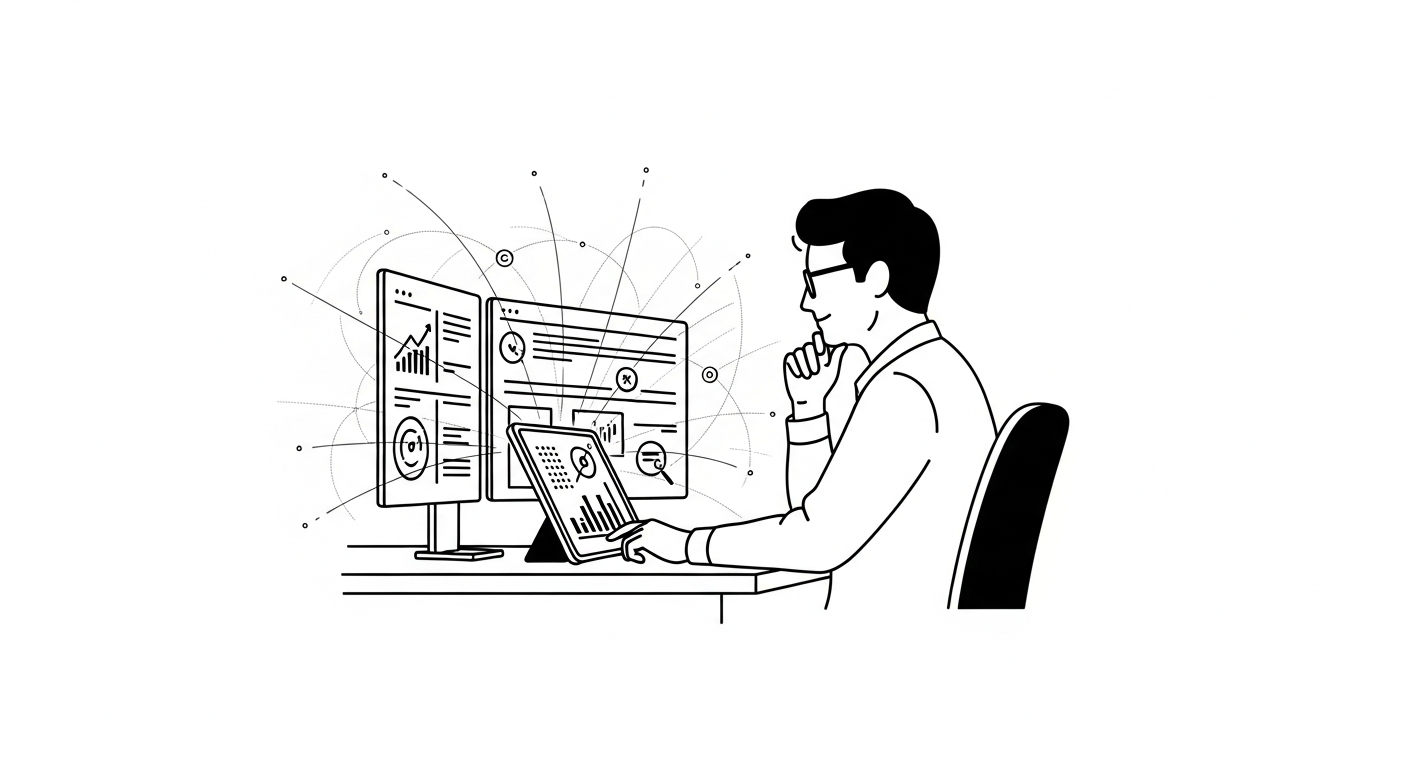
You know the morning routine: open Mercury, then AdSense, then GA4, then Search Console. Eight dashboards, eight context switches, all before your first cup of coffee. What if you could replace that entire ritual with one daily brief, delivered to your inbox, calling out only the things that changed? That's the promise of agent-augmented ops, and it's how I run Total Ventures.
The Dashboard Deluge and the Operator's Dilemma
Every solo operator building and running digital products faces the same challenge: a data deluge. Each product, each marketing channel, each financial stream generates its own set of metrics. You need to know what's happening, but the sheer volume of information can be overwhelming. The problem isn't a lack of data; it's a lack of signal.
Checking dashboards isn't just time-consuming; it's mentally taxing. Each switch requires your brain to re-contextualize, to remember what 'normal' looks like for that specific data set, and to identify anomalies. This constant context switching fragments your attention and drains your cognitive reserves, leaving less energy for high-leverage work.
For years, I learned the hard way that this approach was unsustainable. My focus shifted from building and iterating to monitoring and reacting. The machine I was building to run Total Ventures needed a better way to surface critical information without demanding constant human intervention.
The Agent-Augmented Solution: Your Daily Brief
The core idea is simple: instead of you pulling data from multiple sources, an AI agent pushes only the relevant insights to you. This isn't just a fancy report; it's a dynamic, intelligent brief that understands what 'normal' looks like for your operations and highlights deviations.
Here's how it works in practice:
1. Data Ingestion and Baseline Establishment
My system's first layer of agents connects to all critical data sources: Mercury for financial operations, AdSense for ad revenue, GA4 for website analytics, and Search Console for SEO performance. These agents continuously ingest data, establishing baselines and identifying trends over time. They learn what typical traffic patterns look like, what a normal revenue day entails, and the usual fluctuations in search rankings.
2. Anomaly Detection and Contextualization
This is where the intelligence of agent-augmented ops truly shines. Instead of just reporting raw numbers, a dedicated agent monitors these baselines for significant deviations. Did traffic suddenly drop by 20%? Did AdSense revenue spike unexpectedly? Is a key keyword showing a sudden dip in impressions?
Crucially, the agent doesn't just flag the anomaly; it attempts to contextualize it. For example, if GA4 shows a traffic dip, the agent might cross-reference it with Search Console data to see if there was a corresponding drop in organic visibility, or with Mercury to see if a recent marketing campaign ended. This initial layer of analysis saves me valuable time.
3. The Signal-Rich Digest
Every morning, before I even think about coffee, a concise brief lands in my inbox. This isn't a dump of every metric; it's a curated digest of only the things that changed, with the agent's initial analysis. It might read something like this:
- GA4 Alert: Organic traffic down 15% yesterday. Agent notes: Correlates with a 10% drop in impressions for 'product X review' in Search Console. No recent deploys or known outages.
- AdSense Update: Revenue up 8% week-over-week. Agent notes: Primarily driven by increased RPM on Inky. No significant change in ad impressions.
- Mercury Note: Subscription churn for Total Formula 1 is flat, but new sign-ups are down 5% day-over-day. Agent notes: Investigate recent marketing channel performance.
This brief gives me a clear, actionable overview without requiring me to log into a single dashboard. I can immediately see what needs my attention and where to direct my focus for the day.
The Leverage of Agent-Augmented Ops
This system isn't about replacing human judgment; it's about amplifying it. By offloading the tedious work of data monitoring and initial anomaly detection to AI agents, I free up my time for higher-order tasks:
- Strategic Thinking: Instead of hunting for problems, I can focus on solving them or identifying new opportunities.
- Deep Work: Uninterrupted blocks of time for building, writing, or refining product features.
- Proactive Decision-Making: Catching issues early means I can address them before they escalate.
This is the essence of agentic engineering: designing systems where AI agents handle the routine, the repetitive, and the data-intensive, while the human operator provides the judgment, the creativity, and the strategic direction. It's how one person can effectively run a portfolio of digital products.
Building Your Own Daily Brief System
Implementing a similar system doesn't require a massive engineering team. Start small:
- Identify Your Core Metrics: What are the 3-5 most critical numbers you need to track daily for each product?
- Choose Your Tools: Leverage APIs from your existing platforms (GA4, Search Console, Stripe, etc.) to pull data programmatically.
- Define 'Normal': Establish baselines for your metrics. This can be as simple as a 7-day rolling average or more complex statistical models.
- Set Alert Thresholds: What percentage change constitutes an 'alert'? Start with conservative thresholds and refine over time.
- Automate the Delivery: Use a simple script to compile the alerts and email them to yourself. Tools like Zapier or Make.com can help bridge the gap if you're not comfortable with code.
The goal is to move from reactive dashboard checking to proactive, signal-rich insights. This shift in how you interact with your data is a fundamental component of effective agent-augmented ops.
Always forge ahead.
Stay close to the work by subscribing to my newsletter for more insights on building and running digital products with AI. You can also find resources like the Studio Launch Checklist on the Total Ventures website.
Studio Notes
How I’m building the studio.
The operator’s log — systems, decisions, and what’s working.
Written by
Founder, Total Ventures
Solo-founder building a multi-brand product studio with AI agents. Writing about building, operating, and shipping.